Post mortems in South East being carried out by locum consultants
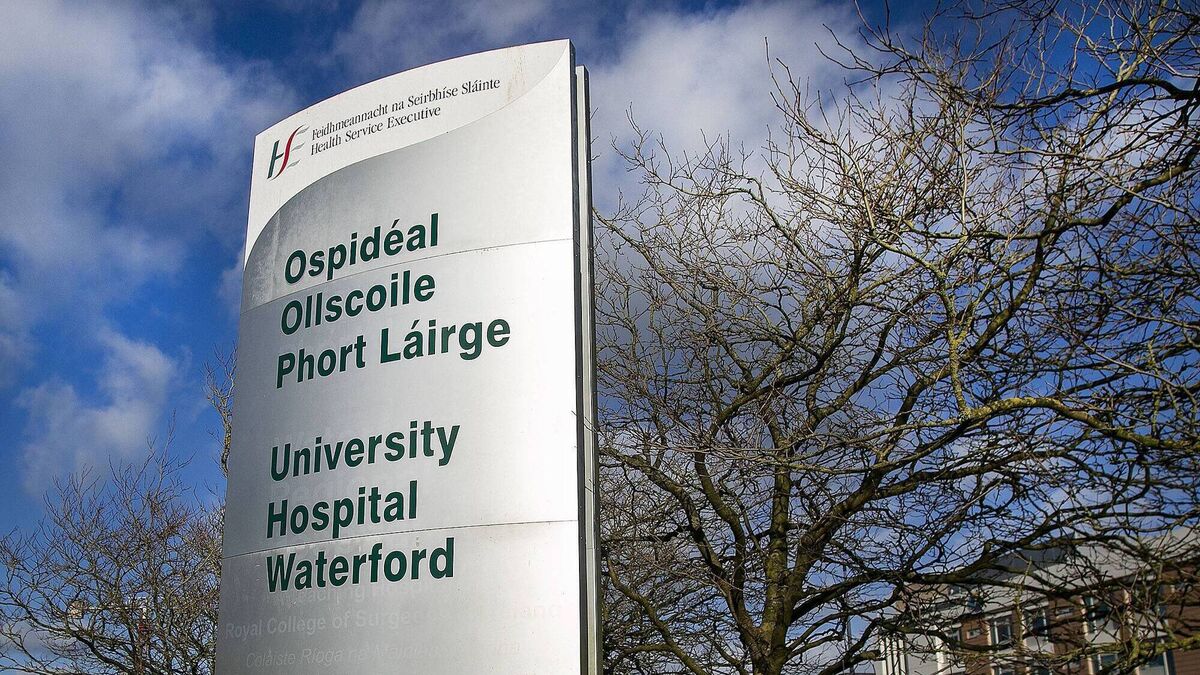
University Hospital Waterford
POST MORTEMS for people in Carlow who have died a sudden or unexpected death are being carried out by “locum consultants recruited by the Department of Justice”, minister for health Jennifer Carroll MacNeill said last week. She added that the available facilities and auxiliary staff of University Hospital Waterford (UHW) had been provided to support the locums.
As reported in on 31 December 2025, UWH, which used to carry out all the autopsies for Carlow, Kilkenny, Tipperary, Waterford and Wexford, informed the HSE in November 2024 that its consultant pathologists would cease carrying out coroner requested autopsies from 2 January 2026. UWH, on average, carries out about 700 post mortems a year.
Minister MacNeill’s statement last week was the first official indication of what the current arrangement for post mortems is since the deadline of 2 January passed. She said that the current arrangement has post mortems being “provided three days per week – that is, Mondays, Tuesdays and Fridays”.
Micheál Murphy TD asked minister MacNeill about the arrangement for UWH post mortems during priority questions in the Oireachtas, prompting him to issue a statement saying: “I welcome these interim arrangements. It is not ideal. It is my understanding that these locum pathologists are coming in from the UK three days a week.
“I know that members of the clergy have spoken publicly on behalf of families. Delays are already occurring. There is a panel of three locum pathologists, but could we look at increasing that number to four or five? Flights can be delayed or cancelled, somebody can have a bereavement or somebody can be sick.”
In response, minister MacNeill said that she would speak to the minister for the Department of Justice and ask him to increase his efforts to try to ensure there are more locum pathologists on the way.
In a letter to deputy Micheál Murphy in 2025, seen by , Ben O’Sullivan, chief executive officer at UHW, said that pathologists at the hospital were ‘struggling to sustain their commitments to the coroners’ service on top of their typical workloads’.
The letter also stated that pathologists at UWH are ‘facing rapidly increasing demands on their diagnostic surgical pathology workloads, both in terms of quantity and in terms of complexity’. UHW is ‘currently significantly understaffed in terms of consultant pathologists and, according to a recent workforce planning exercise, the coroner’s post mortem workload at UHW requires four dedicated autopsy pathologists to be fulfilled’.
Minister MacNeill also made the point that many other hospitals around Ireland have withdrawn their post mortem services over the past few years, including Cork University Hospital, St James’ Hospital, the Mater Hospital, Beaumont Hospital and University Hospital Limerick.
She said: “Historically, the health service has assisted in the provision of coronial post mortem services on a sort of grace-and-favour basis. While consultant pathologists are employed by the HSE, coronial post mortems are carried out independently for the Department of Justice.
“Obviously, that grace-and-favour model is not working. Hospitals are withdrawing from the provision of coronial post mortem examinations for a range of diverse and complex reasons, including a shortage of consultant pathologists willing to undertake that work and increasing diagnostic workloads for an increasing population.”
The pathologist shortage is not just an issue in the Republic of Ireland, as minister MacNeill made the point that “our friends in Belfast are having real difficulty on the paediatric and perinatal pathology side, which is very distressing for families with the loss of a child or a baby. There is a shortage generally, but we have to create a distinction between the justice system and the health system, which continues to do its work.
“We need pathologists to continue to do their work, both in terms of diagnostics and research and also in terms of something that is separate and ancillary and arises as a consequence of the coronial court process. The latter is very much a matter for the Department of Justice.”