Couple in limbo in County Carlow over delay in pyrite houses redress scheme
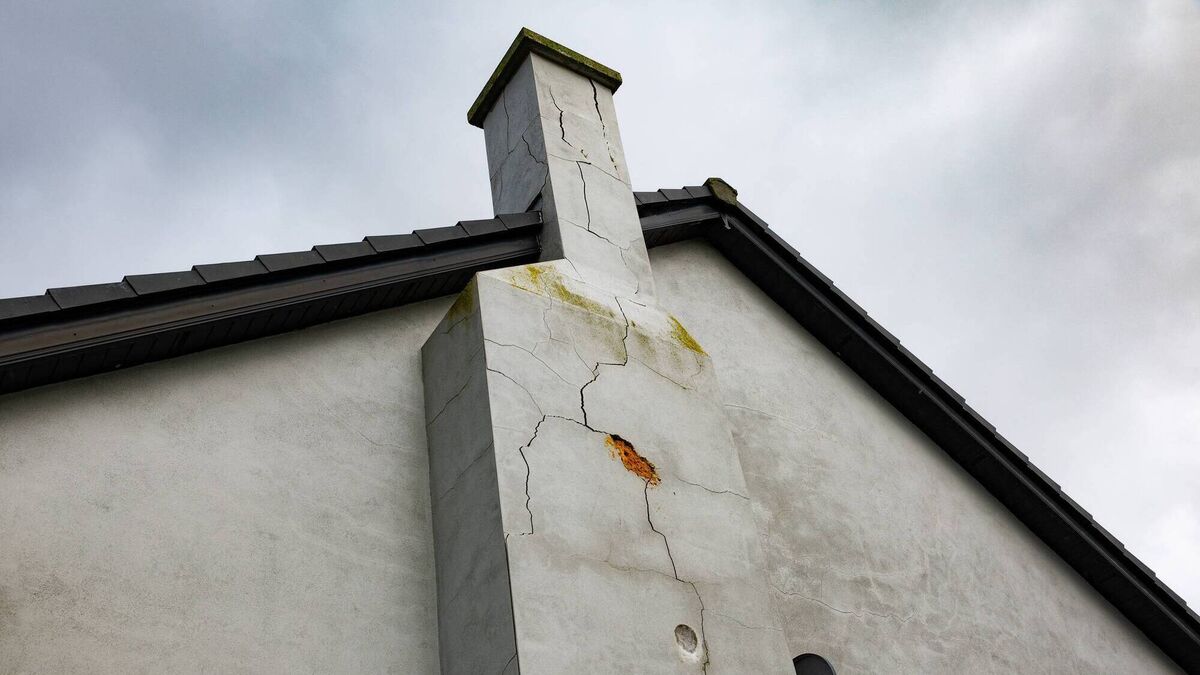
The chimney of a house in Park Gate in Tullow which has been severely damaged by pyrite Photo: Michael O'Rourke Photography
KEITH and Lisa Brady began to suspect that something was wrong with their house near Tullow in 2021, two years after moving in.
“We noticed cracking on the outside of one of the walls. We thought it was just the render settling or something like that,” Keith said.
The couple were not initially suspicious that anything was wrong with the house as it had received a positive engineer’s report two years previously when they bought it. Believing the cracks on the outside wall to be purely cosmetic, they hired a local builder to redo some of the rendering.
“The builder got up some scaffolding and took a bit out of the render. He then got off the scaffold and said, ‘There’s something seriously wrong here.’ He had what looked like a lump of sand in his hand. He said that he put his hand into the wall and pulled out concrete dust,” Keith said.
The couple first tried to get help from their home insurance but were told that construction defects were not covered under their home insurance scheme. They then contacted a local structural engineer, who passed on the name of a company that tests for pyrite and mica. It took a while for the company to get around to test their house because of the number of homes that needed testing at the time, but eventually it got around to testing the Bradys’ home.
The company tested only the wall that had cracks in it, but it cost the Bradys €5,000. Local councillor Charlie Murphy told that he had heard of people paying up to €6,000 for a test.
The report stated that there was a defect in the concrete on the Bradys’ wall.
“We got in touch with the local councillors and we got a call from the head of the fire team in Carlow, who said there were six or seven houses that had been identified as containing pyrite or mica. He said they were trying to get Carlow into the compensation scheme,” Keith explained.
The government first launched a compensation scheme in 2020 for homeowners in Donegal and Mayo whose homes were found to contain mica or pyrite. In the face of significant public pressure, the scheme has since been greatly enhanced, with people from, Clare, Limerick and Sligo now able to apply and the government offering up to 100% compensation capped at €462,000.
Carlow Co Council applied to be included in the scheme in 2023 as it said that a number of homeowners had come forward after discovering that their homes contained defective concrete blocks.
At the time, a council member told Keith that six or seven houses in the Carlow were found to contain pyrite or mica, while cllr Charlie Murphy said that he is personally aware of between ten and 12 houses in the county that have been affected by defective concrete. Cllr Murphy said that he first became aware of the issue three years ago and has been raising it consistently in county council meetings since.
Likewise, John McGuinness, TD for the Carlow/Kilkenny constituency, said that he was personally aware of six houses in Carlow that were affected by defective concrete blocks.
For a county to qualify to join the redress scheme, the Housing Agency must carry out its own tests on homes that local councils have identified as containing defective concrete. The government began carrying out such tests in 2024 and Keith’s house was tested in early 2025.
However, although the government carried out these tests in 2024 and 2025 and are in possession of the results for each house, the Housing Agency will not tell the homeowners if their homes contain defective concrete blocks.
Expressing frustration on behalf of his constituents, deputy McGuiness said: “The reports that have been carried out on the blocks, or house, or wall have not been sent back to the homeowners as the department is still studying them. So a lot of people are waiting on their reports to come back so that they know the extent of the problem or the specific problem that they have.
“It’s not resolved. It’s causing an awful lot of trouble for the households affected.”
Homeowners have been advised that if they do any repairs to the affected concrete before Carlow is added to the list of counties entitled to compensation, they will not be eligible for compensation from the scheme.
Keith feels stuck in limbo. He worries that a part of the render could fall off the outside wall and hurt somebody.
“They told us not to repair the house but won’t give us the report and won’t tell us what’s happening next. We’re sort of stuck in limbo now, with a wall falling down,” Keith said.
The crumbling render is also letting moisture into the house and Keith said that the attic is full of damp.
The Bradys feel that the issue of whether to admit Carlow to the compensation scheme keeps getting kicked down the road. “Every time we contact them, there is a meeting next week.”
On 4 February during a Dáil debate, John McGuinness TD asked the minister for housing, local government and heritage James Browne when the decision about whether to add Carlow to the scheme would be announced. Mr Browne replied that he understood the Housing Agency had completed the report and would be in a position to announce its decision before the end of February.
However, on 20 February, deputy McGuinness said that he had “not seen any sign of the report yet. By the end of February, I will go back and ask again”.
Keith laughs when he says that his family is from Donegal. “My cousin is the chairman of the mica group up in Donegal – it’s a really weird coincidence. They were telling us what has happened, and I’ve seen them going through their stresses over the last ten years.”
The current situation makes Lisa and Keith worry about the future. In the past few years, their children have grown up and moved out and, ideally, they would like to start thinking about downsizing, but with the house in its current state, they cannot put it up for sale.
“We may be left in a position where we have to repair it but can never sell it or do anything with it or it has no value. I’m paying €1,000 quid a month on a mortgage for something that has no value.”