Census 1926 unveils the Story of John J O’Callaghan
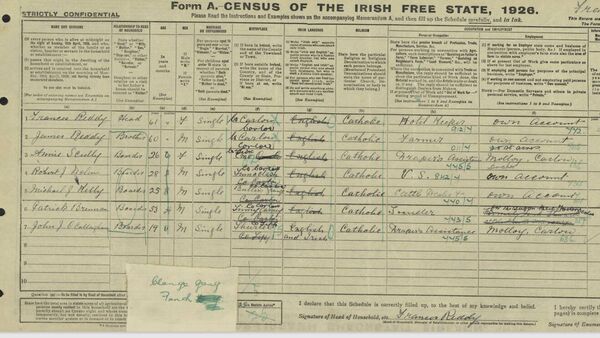
Census Form John J Callaghan
In 1932, 1933 and 1934, he was Carlow’s top scorer in the Leinster Junior Hurling Championship. Yet, in each of those years, he scored just once! Indeed in ’33 and ’34 he was Carlow’s lone scorer.
In 1927, he won a county championship medal with Carlow Hurling Club, a championship of significance in that after a handful of sporadic earlier efforts, the ’27 enactment established a competition which this year will – the ’41 ‘foot and mouth’ cancellation excepted – be celebrating its 100th successful conclusion.
He was among the ‘played wells’ in that victorious ’27 campaign, contested another county final in 1932 when again mentioned in dispatches, and while the small reports in this newspaper back then don’t actually reveal who scored in those county finals, we suspect he was among the flag raisers.
Who is this he? Well, up until 12am last Saturday morning, he was J Callaghan. Possibly Joe Callaghan. Maybe John Callaghan. On one occasion, Joe was attached to his name in a report; a few years later, he was John, but, truth to tell, you couldn’t rule out Jim either, not to mind Jeremiah!
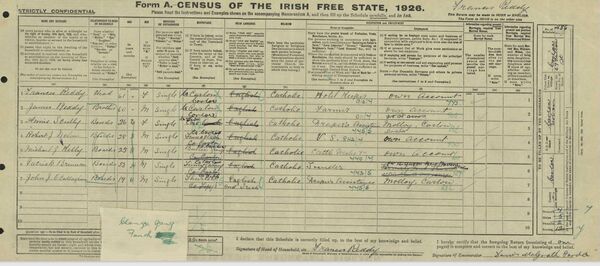
But at 12am last Saturday morning, April 18, 2026, 100 years to the day that the first Irish Free State Census was taken, it was possible to access online the details recorded a century ago. Having spent a lot of time perusing the 1901 and 1911 Censuses, I was looking forward to searching pastures new (I know, I know, a bit of an oxymoron that, but you know what I mean!) So midnight had scarcely passed when my cursor went a cursoring and the first two ‘findings’ were those of my father and mother, born in 1924 and 1925, and scripted in as babies in Kylea and Letterkelly in Inagh, Co Clare.
Next, I decided to try and fill in some missing pieces in the Carlow hurling jig-saw. Starting with J Callaghan. So in I type Callaghan, indicate the county I wish to search is Carlow and also indicate it’s the male of the species is our goal. Up comes a list, one page, a few in Nurney, a few in Tullow, a few in Tinnahinch. And five in Carlow Urban, four Callaghan’s, one O’Callaghan. The one O’Callaghan is the only one whose Christian name starts with J. John. In fact he is John J. Aged 19. Living in Tullow Street.
So I click on the ‘Household Form’ (see our illustration) and we find out he is residing as a boarder in the house of Ms Frances Reddy, a hotel keeper, and her brother James, a farmer. John J is scripted in as a Drapers Assistant in Molloy’s which was also located on Tullow Street.
His place of birth was given as Co Tipperary. Thurles to be exact. The home of hurling. This had to be our hurler, our sharpshooter of yesteryear!
Next stop was Garryvicleheen! Garry-where, you ask?
Well you see I typed O’Callaghan into the 1911 Census with Tipperary on my mind and once more we find John J, five years of age, the son of John, a Draper, and Julia O’Callaghan, living in Garryvicleheen in Thurles Urban. Googled Garryvicleheen and it is actually Friary Street, a street I’ve often traversed when attending matches in Semple Stadium, which, according to the same Google, is just 700m from Garryvicleheen (a handful of Eoghan Connolly long pucks!)
So then, John J was born in the cradle of the GAA and his arrival in Carlow coincided with the birth of Carlow hurling We first read of him in the Autumn of ’27 when a notice appeared in ‘The Nationalist’: “The following members of Carlow Hurling Club - from whom a team will be selected to play Bagenalstown, on Sunday next in the County Championship at Carlow - are earnestly requested to be in attendance at the Barrack Field at 2.30 pm sharp with togs and hurleys; this notification to be taken as final: J. Murphy (Capt.), J. Corr (goal), Mahoney, Quigley, Flynn, Rinn, Behan, Fahy, Rafferty, Donegan, Lynam, J. Conroy, Callaghan, M. Conroy, Clarke, Hughes, Kealy, Kinihan and Timmons.” We read the week after “Carlow settled early and registered a goal and a point per Callaghan and Fahy”, scores which set their side on the way to victory. Fahy has been just J Fahy in our records until Saturday morning. We now know he too was a Tipperary man, Clonmel, a 29 year-old Civil Service Clerk living as a boarder on Athy Street, a place name not in current usage.
The 1927 County final was delayed until Sunday, March 11, 1928, played in Leighlinbridge against Bagenalstown, a notice in this newspaper again naming a panel, which differed a little to that of the previous game: J. Murphy (Capt.), J. Corr (goal), Kealy, Mahoney, Flynn, Finn, Meehan, Quigley, Rafferty, Behan, Clarke, Lynam, Fahy, Callaghan, Kinihan, Timmons, Hughes, O’Rourke. In the same snippet, we learn the team had undergone a special course of training and were due to leave from the Courthouse Square at 2pm.
The training paid off, Carlow beat Bagenalstown 2-3 to 1-4 in ‘a keen battle for supremacy’ in which ‘the play at times reached a very high standard.’ The winners led 2-3 to 0-3 at half-time and failed to score in the second half when “the Carlow citadel was in grave danger on more than one occasion, but the work of the goalman was admirable, and his accurate saving could not be surpassed.” Corr was the designated goalkeeper beforehand, and dare say it was he who starred, but alas, no Carlow Corr appears in the 1926 Census. The net guardian must have come to town that year. Or was out of town the night of the census!
I actually had the pleasure of meeting the victorious ’27 captain, Johnny Murphy, in 1977 when researching ‘Carlow Hurling Memories’. Johnny and his wife were living in Leinster Crescent, and when we called in December, Johnny showed us his medal from that year, and Mrs Murphy plated up a massive slice of Christmas cake with a delightful amount of marzipan atop. The sacrifices a researcher had to make!
Let’s detail John J O’Callaghan’s inter-county career in diary fashion.
On the back of the successful 1927 county championship, played on a league basis, Carlow field in the Leinster Junior Championship for the first time in several years and cause a major surprise by beating Kildare in ‘The Bog’ in Bagenalstown, the final score of 9-4 to 7-1 an outlier for its time. John J played in attack, and while no scorers are detailed, one would imagine he contributed.
A quarter-final against Dublin’s ‘second string’ was the reward for the Kildare victory, and Showgrounds in Athy hosted the fixture, which the Metropolitans won 12-1 to 4-2, John J O’Callaghan scoring a point.
Mission Impossible, taking on Kilkenny’s juniors in their own new Nowlan Park. The black and amber won 10-9 to 0-0, John J playing up front on a team that also included Cork native Tom ‘Whip’ Donegan, whose nickname was derived from the advice he gave to his fellow players.
After the unhappy events of the previous year, Carlow, even though they had home venue in Bagenalstown, were unable to field a team and conceded a walk-over. This stands as the last time Carlow did not fulfil a flagship hurling championship fixture.
No sign of John J on the team beaten 2-3 to 1-1 by Wexford’s ‘second’ string in Bellefield, Enniscorthy.
Captained by Ned Keegan of Bagenalstown, a son of Kilkenny, Carlow again lost to Wexford, this time 6-2 to 1-2 in ‘The Bog’, Bagenalstown, with local maestro Mick Gaynor, another Kilkenny native, accounting for the 0-2, John J O’Callaghan top scoring with a smartly taken goal.
‘The Bog’ again played first-round host, this time to Laois, who returned home 3-8 to 0-1 victors, the lone Carlow flag a nice strike from John J.
O’Moore Park, Portlaoise provides the setting for John J O’Callaghan’s swan-song, Laois beating Carlow 3-4 to 1-0 with the Tipperary natives green flag, his side's lone score, completing a top-scoring three-in-a-row.