Opinion: Ireland’s €209bn national debt deserves more scrutiny than RTÉ salary rows
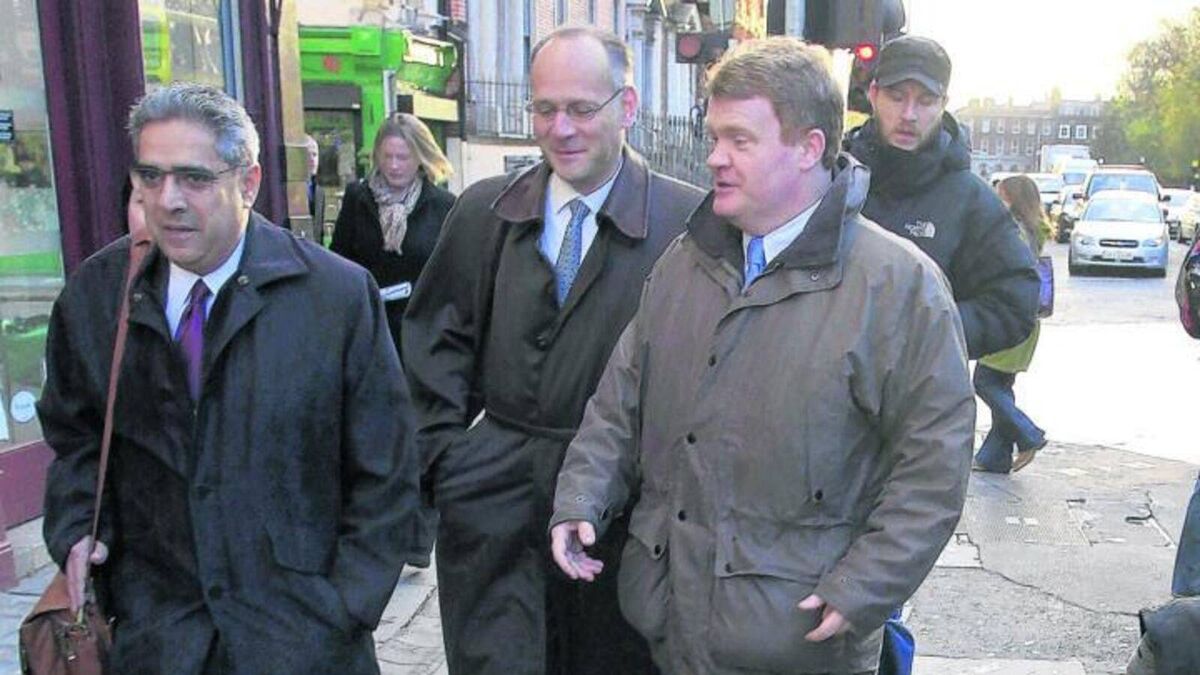
Remember this? Ajai Chopra and an IMF delegation make their way to the Central Bank for crucial talks with the government in Dublin in November 2010
MAKE it personal, especially if you want to deflect away from the bigger picture. That appears to be the view of the Public Accounts Committee when it comes to discussing the finances of this country. And RTÉ, it would appear, is the obvious place to go.
It would appear members of the committee are more interested in how RTÉ wrongly classified an employee, which led to that person being excluded from the list of top earners at the station in 2024, as well as how 41 people were sent to cover a soccer match in Prague in March, rather than spend time discussing a far bigger and more frightening financial matter: that this country has a national debt in excess of €209 billion.
That figure is almost too big to comprehend. It is far easier to concentrate on the small stuff, like whether or not Derek Mooney should have been classified as a presenter or producer, or how could you possibly need 41 people to cover one soccer match.
Initially, I thought that figure of 41 sounded a little excessive, but then look at the level of coverage the national broadcaster gave to that event â which could have seen us on our way to the World Cup â and I accept the figures do appear to stack up.
To tell you the truth, I often listen to Derek Mooney’s radio programme and don’t see the big deal about whether he is either a producer or presenter. In fact, I understand he fulfils both roles, but his salary, as if we really care, couldn’t be divulged unless he was classed as a presenter. So what if the man earned almost €200,000 in 2024? That may sound a lot to you or me, but that is the average paid to the top earning presenters in RTÉ.
What I am more interested in is the €3.5 billion it costs to service the national debt each year â and that figure will grow as the debt gets bigger and bigger.
On the one hand, we are being told we have a booming economy, full employment and spending more than ever before on health, education and so on, with tax returns at an all-time high, but then we hear that we were never as much in the red as now.
The National Treasury Management Agency (NTMA), which delivered the news last week, was formed 35 years ago when the national debt stood at a little over €30 billion. At the time, we were told it wasn’t good practice to carry a large debt which was costing a fortune to service, so this agency was tasked with controlling it.
That all makes perfect sense, but that debt stood at a little over €209 billion last year and is only going in the one direction â up. We are lucky in so far as those managing national affairs have managed to ‘hedge’ things, so to speak, by availing of good, fixed interest rates when they were low, but that won’t continue.
Lest we have forgotten, there was a time not too long ago when this country was on its knees and a lot of the debt we are now carrying and don’t want to know about is because of that.
We were reckless in the early 2000s. We were suddenly the new kids on the block with money to burn, thanks to an over-inflated construction sector. Banks were giving out more money than they had, every second person you met had ‘invested’ in at least one other property, apart from the family home, here in Ireland, with the adventurous ones buying not in Spain or Portugal, but in South Africa, Panama and God knows where else.
But by 2008 the party was over. We were flat broke. The bubble had burst, there was mass unemployment with people losing their jobs by the day. The builders went on holiday and never went back to work, and for a while it looked as though someone was going to turn out the lights on the entire country.
The European Central Bank (ECB) gave a short-term bailout to keep the lights on in 2009 and 2010 and then in November the International Monetary Fund (IMF) sought for, and got, an €85 billion bailout for the country, but at a cost.
The next thing we saw was a few extra columns on the payslip to cover additional taxes and, while the memory of those dark days may have faded for many, those tax columns remain.
A lot of that debt we now carry is thanks to those reckless days and the fact that the government of the day guaranteed all debts carried by banks and financial institutions. While the cost of servicing that debt last year was over €3 billion, it was over €8 billion in 2013, so I suppose we should be grateful for some good news.
A couple of weeks ago, we had wall-to-wall coverage of how much the National Children’s Hospital is going to cost, growing by the minute to where it now stands at close to €3 billion, making it one of the most (if not the most) expensive hospitals in the world to construct.
But here we are quietly paying more than that on a yearly basis just to service a debt that will, by all accounts, continue to grow. Surely someone, somewhere will have to cry halt at some stage.