Man handed lifetime animal ban after dog found ‘eaten alive’ by maggots.
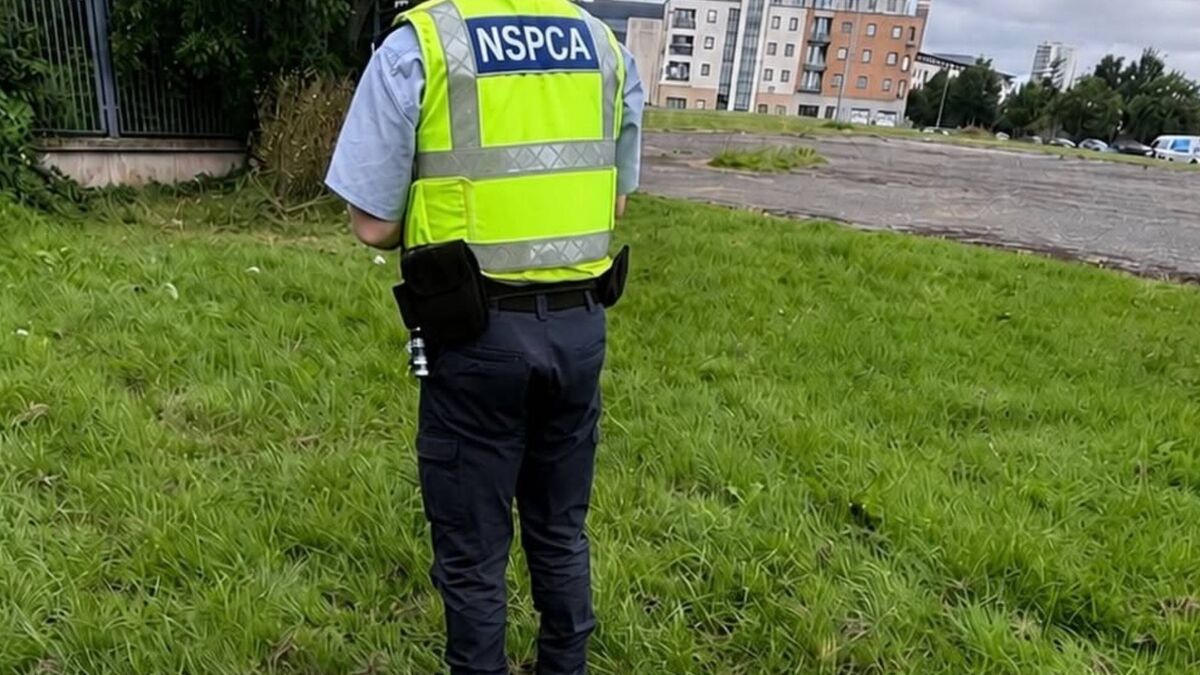
Image of an NSPCA officer from the NSPCA Facebook page
A CARLOW man has been handed a lifetime ban on owning animals and fined €1,500 after a court heard his dog was found in such an advanced state of maggot infestation that a vet described her as having been “eaten alive”.
Cuan Prendergast (43) of The Ridge, Old Leighlin, Co Carlow pleaded guilty to five charges brought by the Department of Agriculture following an investigation by the National Society for the Prevention of Cruelty to Animals (NSPCA).
Brian Kearney BL, instructed by the minister for agriculture, prosecuted the case, in which Mr Prendergast accepted the facts and offered no evidence in mitigation.
Senior animal welfare inspector at the NSPCA, Fiona Conlon, told the court that at approximately 8.30pm on 25 June 2025, a local veterinarian received a call from a member of the public reporting a dog in poor condition on the Old Ridge Road at Old Leighlin, Carlow. When the vet arrived at the location, a black labrador, later identified as Ruby, was found in a severe state of neglect.
The court heard that the dog was “crawling in maggots” and was also emaciated, with an ulcer on the right side of her head and holes in her head and legs caused by maggot infestation.
Ms Conlon told the court that, in the vet’s professional opinion, the animal had effectively been “eaten alive” with the infestation eating through to her body, and the only humane option was to euthanise the dog back at the surgery. Following the procedure, a microchip was discovered which confirmed Ruby’s identity, with the chip registered to a property directly behind the hedge where Ruby was found.
Ms Conlon told the court that when she visited the property, Mr Prendergast explained to her that he had two dogs and that Ruby had run away roughly a year earlier and had not been seen since.
Ms Conlon said she did not accept this account, telling the court: “I believe it was his dog; I don’t believe the dog had run away.” She said Mr Prendergast told her he had noticed a scratch on the dog’s head and had applied a blue disinfectant spray to it, but that the dog had never been treated by a vet for it.
Photographs of the dog’s injuries were handed into court. Judge Miriam Walsh, visibly affected by the images, said: “My stomach is turning from seeing these pictures – I have never seen this before. I can’t even tell what part of the body that is.”
Ms Conlon confirmed that the photo in question showed maggots coming from the dog’s vulva.
Mr Kearney raised a query flagged by defence solicitor Elizabeth Cass regarding summons 4, a section 13 offence relating to the provision of suitable and wholesome food. He put it to Ms Conlon that section 13(1)(b) requires a person with a protected animal to provide a sufficient quantity of suitable and wholesome food and asked whether the dog’s emaciation was linked to this. Ms Conlon responded that, while she was not a trained vet, she believed the emaciation was more likely a consequence of the dog’s illness than a lack of food, adding that Mr Prendergast’s other dog was of normal body weight.
Mr Kearney acknowledged that there had been engagement on Mr Prendergast’s part and a recognition of the gravity of the situation and that he accepted a lifetime ban from owning animals would likely be imposed on him.
Under questioning from the defence, Ms Conlon described the condition of Mr Prendergast’s property as overgrown, unkempt and dilapidated, saying it was difficult to tell a house was even there until passing through the gates. She confirmed that Mr Prendergast had complied with a notice to get a new kennel and to have his other dog, Gizmo, described as being 13 years’ old and blind and nervous, examined and treated by a vet.
She said she had not investigated the food provided to the dogs, but that Gizmo appeared to be of normal body weight and behaviour typical of an elderly, blind animal.
Ms Conlon said that Mr Prendergast had not fully co-operated at the time of her single visit, appearing shocked at her presence, and confirmed that of the photographs shown to the court, one was taken while the dog was still alive and the remainder after she had been euthanised. She noted that the second dog, Gizmo, died approximately six months after the visit, with vets satisfied that his death was not linked to neglect.
Ms Conlon added that when the dogs originally came into Mr Prendergast’s care, he had acted responsibly in having them chipped and neutered.
Judge Walsh was strongly critical of the defendant’s conduct, telling the court she was “appalled” at the dog’s condition, describing the images as “horrendous” and “unbelievably awful”.
Putting a hypothetical question to Mr Prendergast directly, Judge Walsh asked what he would do if he injured his own leg and it became ulcerated and infested. Mr Prendergast responded that he would go to a doctor, “sooner” rather than later.
Ms Cass noted that her client had not, in fact, attended a GP in years.
Judge Walsh said, “Why would you put another living being through this form of torture? Would you treat yourself like this?” – to which Prendergast answered “no”.
She described the case as “unconscionable” and said she was struggling to understand why anyone would allow another creature to suffer in this way.
In mitigation, Ms Cass told the court that this was the first time Mr Prendergast, who has no previous convictions, had ever been reported to the authorities. Ms Cass explained that he lived alone in an isolated area in poor conditions and suggested there may also be an element of self-neglect involved, again noting that he had not attended a dentist or doctor in many years.
She characterised his conduct as neglect rather than a deliberate act, pointing out that he had applied disinfectant spray to the wound himself, and said he was a private person “who goes about his business”.
Ms Cass added that Mr Prendergast, who works with young school leavers, teaching IT at a Youthreach Centre, had co-operated with the investigation and entered his guilty plea at the earliest opportunity.
Noting the guilty plea and absence of any previous convictions, Judge Walsh imposed two separate fines of €750, to be paid within three months, and imposed a lifetime disqualification order, banning Mr Prendergast from owning or keeping any animals.
The fourth summons, relating to the section 13 offence for the provision of suitable and wholesome food, was struck out, while another summons was taken into consideration.