Carlow holy wells and place names projects showcased at CHAS heritage lecture
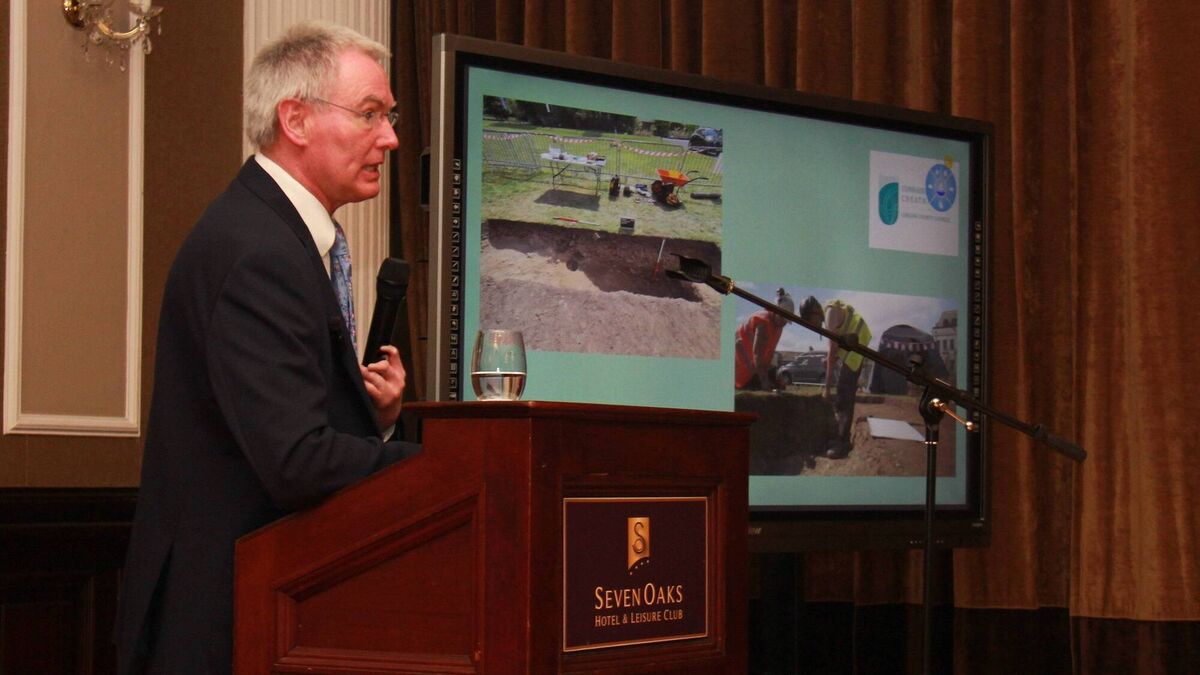
Eoin Sullivan presents his talk titled 'Heritage at the heart of Carlow Co Council' at the Seven Oaks Hotel Photo: Paul Curran
CARLOW Historical and Archaeological Society (CHAS) was treated to an illuminating lecture on the county’s rich heritage in the Seven Oaks Hotel on 15 April, with county heritage officer Dr Eoin Sullivan outlining the breadth of local projects supported under his tenure.
Dr Sullivan’s talk, titled , spotlighted a range of initiatives spanning built heritage conservation, archaeological excavation, place names research and a pioneering holy wells project that enlisted the help of a psychotherapist to measure the wellbeing benefits of heritage engagement.
Acknowledging the contribution of community groups and CHAS members over the past five years, Dr Sullivan stressed that heritage funding is not reserved for large institutions or grand estates.
“I wanted to show the members that there is funding available and it’s not just for the big house; it’s for the community groups or smaller entities,” he said.
Projects highlighted included built heritage conservation work ranging from large properties such as Boris House to smaller, community-led efforts like the cleaning of the Kavanagh monument in Borris. Dr Sullivan also detailed a test excavation at Carlow College last year, funded by the Community Monuments Fund, which successfully located a 17th-century defensive ditch. Further excavation at the site is planned for later this year.
The Carlow Place Names project was also discussed, with Dr Sullivan describing how it built on earlier research carried out by CHAS members and expanded into a countywide initiative.
“That was feeding off a project that the CHAS members had done over the last number of years. We were able to take that and kind of amplify it a little bit and open it up to a countywide project,” he explained.
Perhaps the most striking project outlined was the Carlow holy wells initiative, which took an innovative approach to demonstrating the value of heritage engagement. With approximately 50 holy wells across the county – many associated with curative traditions for ailments ranging from warts to depression – the project sought to quantify their impact on participants’ mental wellbeing.
Two free coach trips were organised last year, bringing participants to holy wells, with lunch provided at the Tyndall Community Hub. Local poet Clifton Redmond, who had written a series of poems inspired by the wells, also joined the outings.
The results were telling.
“When they had done all the analysis of the results, there was a marked decrease in people’s stress level from the beginning of the day to the end of the day,” said Dr Sullivan.
Dr Sullivan was also keen to credit the wider community for the dramatic growth of Heritage Week events in the county, which have risen from around a dozen to 50 during his time in the role.
“This isn’t as a result of me; it’s as a result of the community groups now being facilitated to get funding and get so active. The appetite’s always been there, but, as I said to them: I’m just a conduit to get that enthusiasm out,” he said.