Urban speed limit causes friction at Carlow council meeting
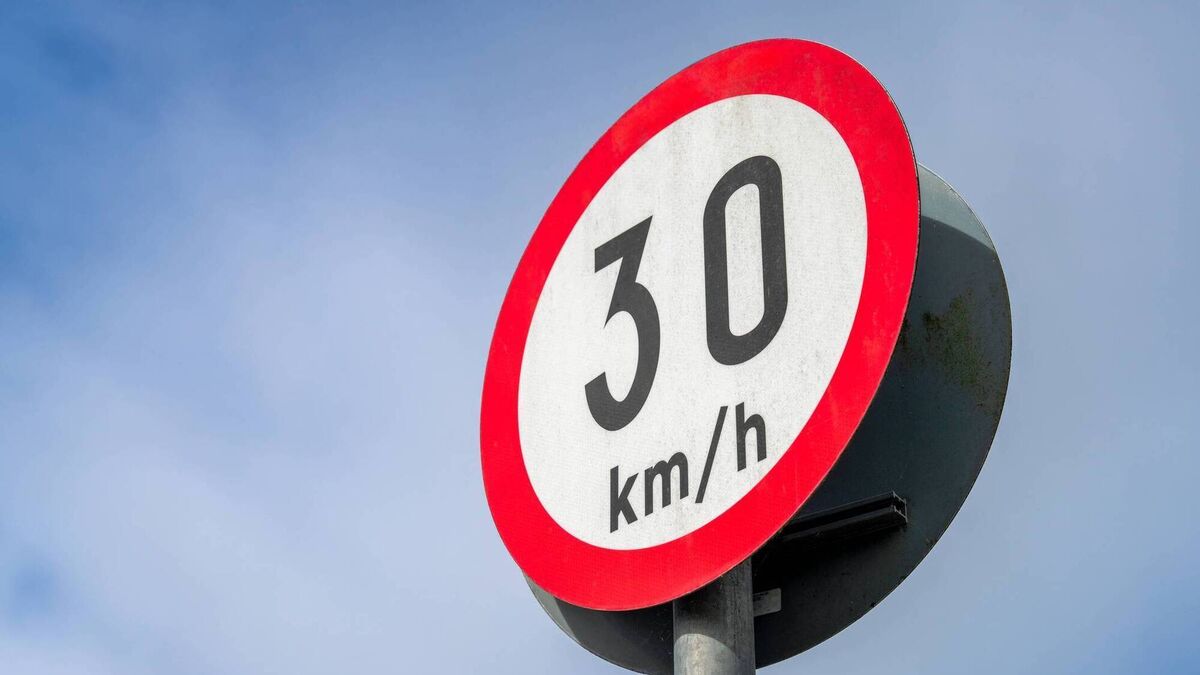
Stock image of a sign for a 30 km/h speed limit in Ireland
A DISCUSSION about reducing the speed limit in urban areas in Carlow caused some disagreement among councillors at the Tullow Municipal District meeting last week.
Orla Barrett, senior engineer, presented the council’s findings from a recent workshop and asked the councillors to agree to open a public consultation on urban speed limits across the county. The consultation is part of a national process where each local authority is getting the chance to draft its own guidelines or by-laws on how it will increase the number of 30kph zones.
The Department of Transport has said all local authorities should implement the reduced speed limits by the end of March 2027.
The Road Safety Authority outlines that a change to 30kph limits would make roads less dangerous, encourage people to choose active travel, leading to better health, improve the economy, make traffic move more smoothly, reduce air and noise pollution and transform car-dominated roads into vibrant living ‘people-friendly’ spaces.
One of the options open to Carlow Co Council, said Ms Barrett, is to introduce a permanent 30kph speed limit around schools or a periodic speed limit “at the bare minimum”. This would operate for 30 minutes before, during and after school is over. She pointed out that this periodic speed limit is already in operation at Carrigduff NS in Bunclody.
For the periodic limit, there would be a normal 50kph sign most of the time and a 30kph flashing sign during school hours, she explained.
Other areas where they are considering implementing a 30kph speed limit is the “business end of town, where somebody is going to be walking across the road with their shopping,” explained Ms Barrett.
They won’t be dealing with schools along regional roads where an 80kph speed limit is in operation, as it isn’t possible to suddenly drop the limit to 30kph.
Ms Barrett also agreed that physical engineering measures to slow people down, not just limited to ramps, will be part of the discussion.
“Where we are proposing 30s, these are areas that you would, under normal circumstances, feel ‘yes, I should be doing 30, because I could take a pedestrian out of it or there’s people going over and back on the road here or there’s a school’,” she said.
Despite agreeing to go for a public consultation, cllr Ben Ward explained his scepticism about the proposed speed limit drop. He said the 60kph speed limit introduced on all local roads didn’t work: “I mean, no-one does that,” he said. “There’s no enforcement of it.
“But even if 30 was enforced, it would be very slow. I think if 50 was enforced, people would be a lot safer,” he continued.
He also argued that changing speed limits during school hours would be confusing for the public and that it contradicts the decision to reduce the speed limit of the whole N80 rather than just part of it.
Cllr Will Paton agreed with cllr Ward and called periodic speed limits “ludicrous”. He expressed concern that gardaí would use a new lower speed limit in towns to try to fill a roads policing quota rather than enforcing the real speeding perpetrators on main roads.
“All these plans we have, they’re great, but they’re not worth the signs they are written on unless we have enforcement,” cllr John Pender put it simply.
“I’d have to disagree entirely,” said cllr Brian O’Donoghue. “I’d rather listen to grief from the public that the speed limit is too slow than for us all to have to go to some huge funeral of a child who has been hit by a car.”
Hitting the philosophical high notes, cllr Paton asked him if he was okay with penalising the actions of the majority for the sake of the individual, to which cllr O’Donoghue replied “100%”.
Ms Barrett said that during a workshop with An Garda Síochána, it was agreed that enforcement is an issue. She said they would look at using speed detections on periodic signs to give them an idea of how many people are breaching the speed limit, but not for issuing fines.
She said the plan is to open up the by-laws for public consultation in September.