Plan for massive solar farm in Maganey is dismissed … for now
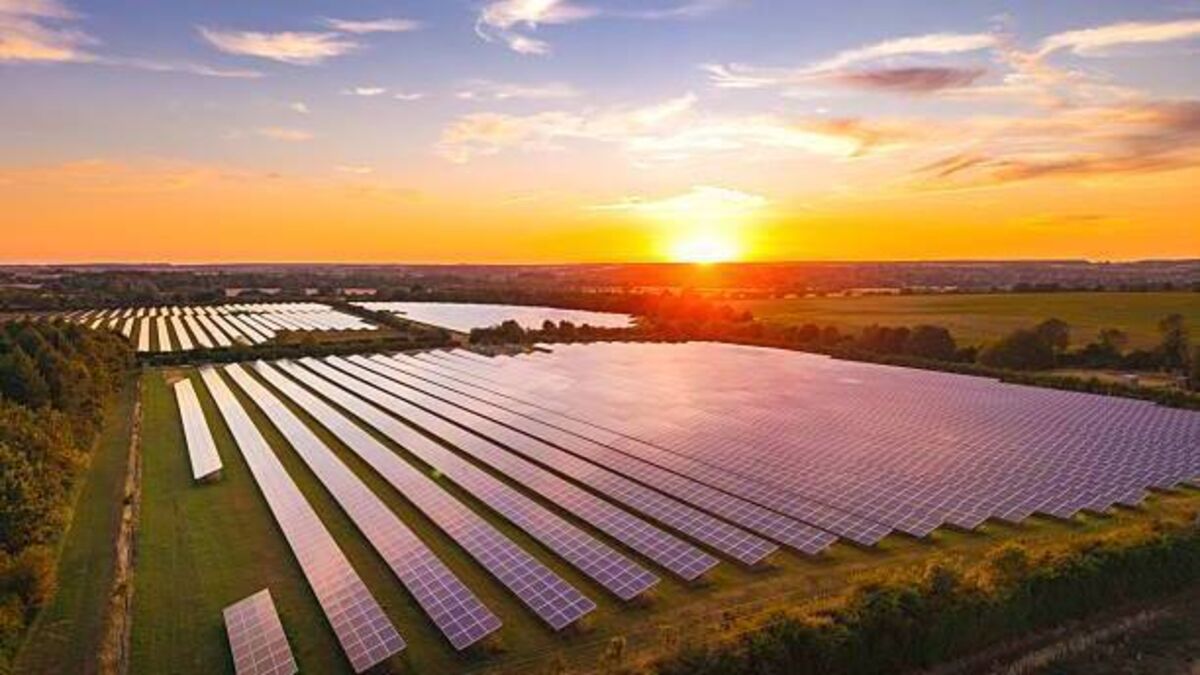
Image of solar farm is for illustration purposes only Source: iStock
A CONTENTIOUS plan for a massive solar farm on the Carlow boarder as been dismissed by Kildare County Council for the time being.
The local authority returned an ‘incomplete’ verdict after a public submission phase and its own assessment of the application by solar energy company BNRG for Maganey.
The council said the developer failed to provide adequate information in its application. While the news was welcomed locally, this still leaves the door open for an updated, improved application and does not represent a permanent rejection of the project.
The 129.8-hectare (320.7-acre) proposal included 496,308 square metres of solar panels, along with 48 battery energy storage system containers and 12 medium voltage stations.
In its planning report, the council said that BNRG’s application lacks sufficient environmental information to allow a full assessment.
According to the council’s planning report, the proposed development is hydrologically linked to the River Barrow and River Nore special area of conservation (SAC). The council said a future application would need stronger evidence and additional environmental assessment to show that the proposal would not adversely affect the SAC.
The planners also found shortcomings in the ecological information provided, noting that only one winter bird survey had been completed, when a second one is usually expected for a project of this scale.
The report noted that the proposal involves the removal of around 417 metres of hedgerow and trees, with the local authority saying an assessment carried out by an arborist should be submitted.
There were 141 submissions on the proposal, the vast majority from locals concerned about the project.
The council said any future application should address concerns raised in the submissions and provide further information related to transport, roads, the impact on Kilkea Castle, battery fire risk and the Gas Networks Ireland pipeline crossing the site.
Chairperson of Maganey Solar Concern Group, Stephen Croncota, felt that the council’s decision was appropriate, while also highlighting issues with the council’s planning report: “I would say that I feel cautiously optimistic. We feel that not approving the proposal or the application was absolutely the right thing for the county council to do.” He described the application as “egregious on a number of fronts”.
He continued: “We know that these things have a tendency to come back with reapplications. We do not know for sure, but BNRG may be already working on a new application. We hope not, but we are realists knowing that it might not be the final chapter.” He was glad that the case had not gone before An Coimisiún Pleanála, at least for now: “I think that if we'd gone to An Coimisiún Pleanála, it was going to be risky. We certainly know we may still end up in front of An Coimisiún Pleanála one day and we're trying to prepare for it. We hope not because every level this goes up, it gets more and more expensive to fight these very rich companies with very deep pockets.” He expressed his view that the council’s planning report did not even touch upon all of the problems with the application.
He hopes that the campaign does not need to “go on and on” and added: “Pretty much everybody who looked at it thought it was a very problematic proposal and application for a number of reasons.” Asked if he and the other locals would be possibly open to a revised BNRG application, Mr Croncota said: “If BNRG were to drastically rethink their application, we would, obviously. Everyone would get together and review it in its new form, of course. But it would be hard to envision how this area is right for a 320-acre industrial solar farm, given all the things I said before. Given it's farmland, it's family neighbourhoods, narrow country roads, all of those things.” Dublin-based BNRG were contacted for comment but had not responded at the time of going to press.
Locals in Maganey expressed their discontent with the proposal at a public meeting in February. Local councillors later disagreed over a motion regarding the use of agricultural land for commercial solar development, with Kildare County Council rejecting a call to consider only industrial sites in the Athy municipal district as locations for such projects.
The response indicated that the council will not automatically rule out solar farms on non-industrial land, with each application assessed individually based on planning policy, environmental impact, the local area plan, government guidelines and feedback from residents and other relevant bodies.
The executive of the council told a meeting in September that they would ask the government for a national planning statement covering large-scale solar farms.
There are currently no specific national planning guidelines in place for solar energy developments.
Minister James Browne said in September that his department is working with the Department of Climate, Energy and the Environment on the national planning statement.