Treasure trove of items found in Ballymoon dig in County Carlow
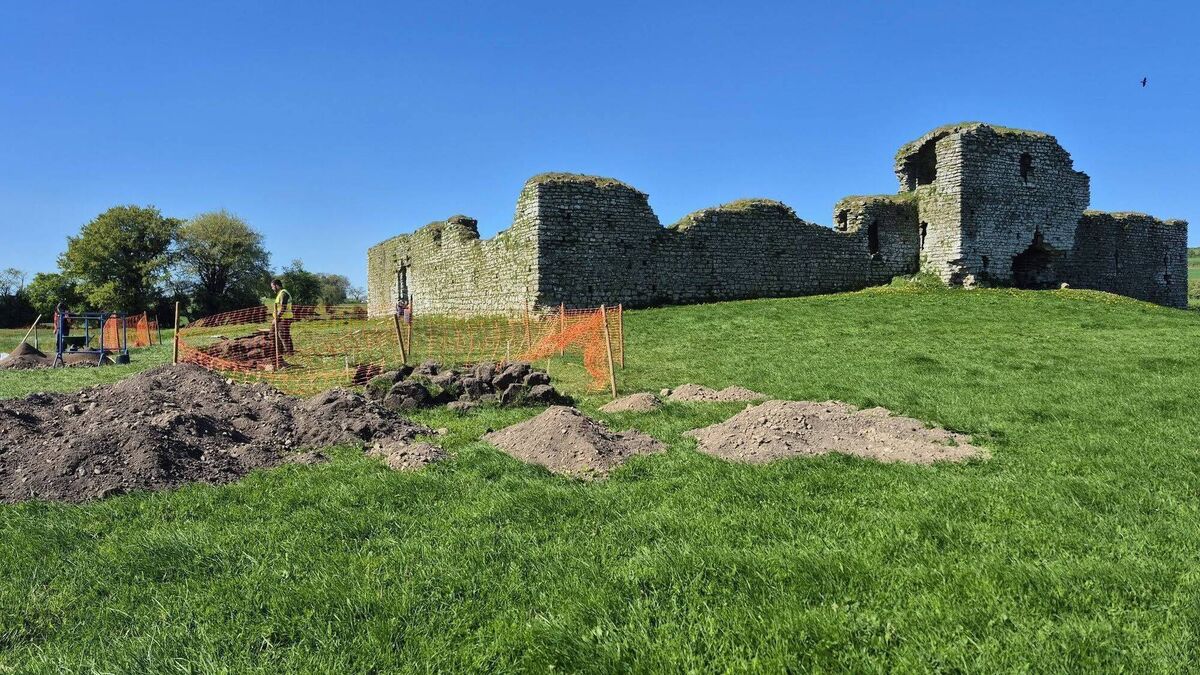
The archaeological dig underway in the grounds of Ballymoon Castle
ARCHAEOLOGISTS funded by the Royal Irish Academy and Carlow Co Council have completed a two-week archaeological dig at the grounds of Ballymoon Castle.
This is the second dig the archaeologists have completed in the past two years. The idea to excavate part of the grounds of the castle came about after the grounds were geothermally imaged and revealed that the castle was once at the centre of a substantial settlement.
The dig has revealed a treasure trove of items that the archaeologists believe date from the 13th to 15th centuries, particularly from Anglo-Norman settlers.
Ballymoon Castle is thought to have been built between 1280 and 1300 by Roger Bigod, who was the fifth earl of Norfolk and a member of the Carew family. It sat on the edge of the Anglo-Norman settlement, with the Gaelic Irish McMorrough family’s lands believed to be only a few miles away. The McMorrough family are still in the area, today known as the McMorrough-Kavanagh family and residents of Borris House.
Roger Bigod fell out with the then-king of England, Edward I, so the lands and castle at Ballymoon went to the crown.
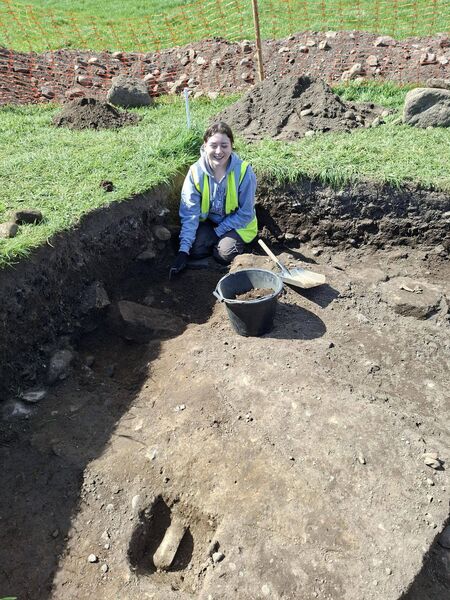
Nial O’Neill, who is the site manager of the Ballymoon dig, believes that the McMorrough family then took over the lands during the period known as the ‘Gaelic resurgence’. This period was from 1350-1500 and saw native Gaelic lords and lords originally from the Anglo-Norman elite who had ‘gaelicised’, regain dominance on the island.
However, in 1520, the Carew family remembered that the lands around Ballymoon had once belonged to them and petitioned a court in Dublin to have the lands returned. They won their case, kicking the McMorrough family out. In 1585, the Carew family sold the lands to the Bagenal family.
While there has long been a local rumour that the castle was never completed, Nial said that this is completely untrue. The castle was completed in the early 1200s and was occupied until at least the 1600s.
The Bagenal family stayed in the castle for about 40 years before deciding to build a new primary residence on the land, Dunleckney Manor. They then decommissioned the castle and took much of the stone from the castle’s upper levels to build the new manor house, leaving just the ground and first floor of the castle’s walls standing.
The Bagenal family also established a new settlement, Bagenalstown, as it was on the River Barrow â rivers were becoming increasingly important for trade as goods began to be primarily transported by barge or ship. It is then believed that over time the people who lived in the settlement around the castle moved to Bagenalstown as it became a centre for trade.
Many of the objects that the archaeologists have found there have not yet been identified, as Nial explained: “Everything from this time is made bespoke to order. No-one is making, like, a million six-inch nails.”
Objects also often only partly survive as one part decomposes while other parts survive in the ground, so it is the job of historians, archaeologists and other experts to debate the uses of certain items.
Now that the dig is over, Nial said that the next step is to have the finds looked over by experts.
“We need to send the pottery to a medieval pottery specialist. The finds need to be conserved by a conservator. Soil samples, we take to a botanist, so they can identify the species in the soil. Then, if there are good surviving wheat or oat grains, we send them on for radiocarbon dating,” Nial said.
The radiocarbon dating could identify in which year the grains were grown and for how long the village was inhabited.
Once all the experts have come back to Nial, he plans to publish the dig’s findings in and The Royal Irish Academy’s own journal.