Carlow mother's fight for access to drug that can slow son’s devastating condition

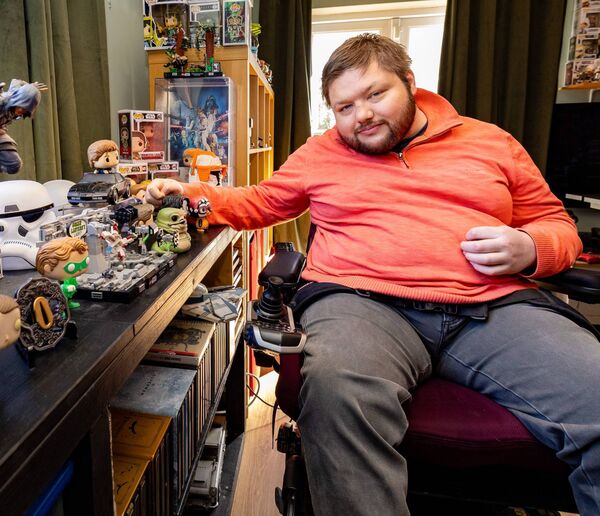
Oisín Pollard from Bagenalstown who suffers from Friedreich's Ataxia is pictured with his parents Elaine and Niall Photo: Michael O'Rourke Photography 2026
ELAINE Pollard watched her son Oisín go from a slightly clumsy child to a young man in a full-time electric wheelchair. Now she is fighting the HSE for access to the only drug that can slow the relentless progression of his devastating condition before it is too late.
There is a moment that stays with Elaine that reminds her why she will not stop fighting.
It was Oisín’s birthday last October. His mother expected it to be a celebration. Instead, her son looked at her and said: “Look, I’m 27. How long more have I left?” Oisín Pollard, who lives with his family in Ballycormack, Bagenalstown, has Friedreich’s Ataxia (FA) a rare, progressive neurological disease that has no cure and, until recently, no treatment of any kind. He was nine years old when he was diagnosed - a boy described by his mother as slightly clumsy. Nothing alarming. Nothing that would prepare a family for what was coming.
The condition takes, steadily and without mercy, the things most people never think to value - the ability to walk, to speak, to make yourself a cup of tea.
Oisín’s decline has followed that cruel trajectory. He moved from walking unaided, to a rollator, to a manual wheelchair, to an electric one. Now, at 27, he is in that wheelchair full-time and needs increasing support. A couple of months after his diagnosis, a further blow arrived when tests revealed he also had a heart condition and had to be fitted with a defibrillator.
Through all of it, says his mother, Oisín has faced his illness with dignity. “He’s the type of person who takes everything in his stride and tries not to dwell on the progression of his disability.” But the progression continues regardless. One of the most devastating effects of Friedreich's Ataxia is the gradual loss of speech. It is already beginning to affect Oisín. His family is now exploring the possibility of having his voice recorded, of preserving, in some small way, the sound of him as he is now before that, too, is taken away.
“Eventually, with his disability, he will lose all his skills,” says Elaine. “You’re looking at your whole mobility going and you could be bedbound, not able to speak, sometimes sight can go, hearing can go. If you were to think about it on a daily basis, it's horrendous. So, we just try and get by day-to-day.” In 2023, for the first time in the history of Friedreich’s Ataxia, a treatment was approved in the United States. Skyclarys does not cure the disease, but it slows its progression and for families like the Pollards, that difference is everything.
“There was great excitement when we heard this,” says Elaine. “We thought now we’d have something to help Oisín.” In February 2024, Skyclarys was approved for use across the European Union. Three EU member states - Italy, France and Spain - now reimburse the cost through their national health systems. Ireland does not.
Thanks to campaigning by young people with FA and their parents, a reimbursement application was submitted to the HSE earlier this month. The National Centre for Pharmacoeconomics (NCPE), which assesses drugs for cost-effectiveness, assessed Skyclarys last year and delivered a recommendation that has left the families reeling - the current price of the medication, it found, is too high.
“They’re saying that our children’s lives are not cost-effective,” says Elaine.
There are approximately 200 people living with Friedreich’s Ataxia in Ireland. “Surely to God their lives are worth fighting for.” Despite everything, Oisín has built a life and works part-time at Carlow County Development Partnership.
What would Skyclarys mean for him? “He’d still be able to work part-time, meet his friends for a coffee, go out for something to eat.” “We as a family are living looking at our son deteriorating in front of us and he knows he’s deteriorating and it’s out of our control. There’s nothing we can do. And this drug would be life changing.”
Oisín himself put it with clarity in a written statement read in the Dáil in February, when five campaigners, with the help of TD Peter ‘Chap’ Cleere, were invited to make their case directly to politicians.
“I’m currently still able to do a lot of things for myself, with a little help - small things like drinking a cup of tea or bigger things like washing myself in the shower,” he wrote. “Ten years ago, I would have made that cup of tea myself … If I make it another ten years, I probably won’t be able to do any of that. I probably won’t be able to do much of anything for myself.” “Ireland is in the EU,” Elaine says firmly. “So, surely we’re entitled to Skyclarys. There’s only a small cohort in Ireland looking for this drug. They should be able to allocate the funds. Because it’s so progressive, what someone with FA was able to do six months ago could be gone in a year’s time or less. Skyclarys just slows it down. They want to build a life for themselves, that's all anybody wants.”