Assumptions contained in the Mazars report ‘cost college staff their jobs’
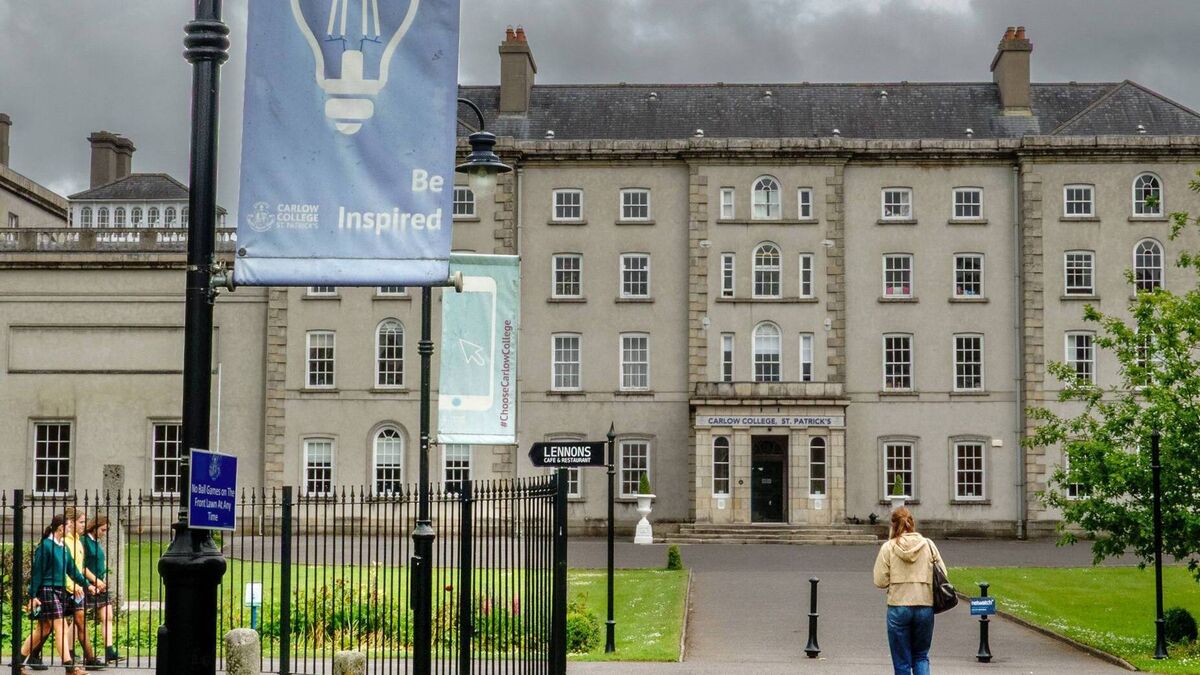
87 Carlow College staff now face redundancy following the decision not to integrate the college with SETU Photo: michaelorourkephotography.ie
STAFF at Carlow College have said the consultancy report which led to the decision to close Carlow College “presents a selective and incomplete assessment” of the college’s research activity and “fails to provide a full picture of staff expertise”.
A spokesperson for the Carlow College Staff Action Group said the report, which described the research output of the college as “low”, excluded significant contributions such as forthcoming publications, conference presentations, research reports, consultancy and practice-based research.
Mazars determined that the research output from Carlow College was “low”, noting only 66 publications from 19 staff between 2020 and 2025. The report says the college currently has no research partnerships, and the only recent external grant was €20,000 from the HSE.
It found that Carlow College would be “highly unlikely” to meet the research-metric requirements for Technological University (TU) integration.
‘SETU has ambitious research objectives, and the is demanding; in this regard, the addition of Carlow College research activity would be unlikely to assist significantly in meeting such objectives and might even dilute focus on research priorities,’ the report says in its ‘summary of risk’.
The Carlow College staff group’s spokesperson said the report’s suggestion that the college’s research would not contribute to SETU’s ambitions “overlooks” the fact that 75% of Carlow College staff held PhDs and that SETU’s own strategy prioritises the humanities and social sciences.
“Staff are being denied the opportunity to demonstrate how their expertise could contribute to SETU and the south-east, while the consequences of these untested assumptions are costing people their jobs and livelihoods,” the staff spokesperson added.
The full due diligence report on Carlow College’s proposed integration with South-East Technological University (SETU) has been given to members of the Oireachtas Committee on Further Education after the university refused to release it in full under freedom of information.
The full unredacted report, which has seen, was crucial to the decision to close Carlow College over the next two years, with all associated land and buildings on the 17-acre site being transferred to SETU.
The report compiled by consultancy firm Forvis Mazars was provided to SETU’s governing body on an interim basis in November 2025 and in its full form in February 2026. It was funded by the Technological Sector Advancement Fund, administered via the Higher Education Authority.
SETU made the decision in late September to share the full unredacted report with members of the Joint Oireachtas Committee on Further and Higher Education, Research, Innovation and Science.
When requested the report under freedom of information legislation on 31 July, SETU refused to release it in full, citing risks to ongoing negotiations and commercially sensitive information. The copy supplied had virtually every page blacked out, including all seven risk areas.
has since seen the consolidated report and all seven reviews behind it, covering finance, governance and legal, HR, academics, student services, IT and research. The central finding is that Carlow College was ‘not financially viable in its current form’.
The report describes a ‘small, financially vulnerable, humanities/social sciences-focused institution requiring stabilisation, restructuring and investment before any integration with SETU could be considered low risk’.
Mazars identifies no ‘singular “red-flag” barrier that legally prevents integration’ but does identify ‘multiple converging medium-to- high-level risks that SETU would inherit without significant external support’.
‘Without external intervention and bridging support, integration would immediately place a net cost burden on SETU,’ the report states.
The financial review offers the most clarity as to why a merger between the two institutions was not pursued.
Carlow College’s net assets fell from €12.4 million in 2019 to €6.99m in 2025, a drop of 44%.
Cash fell from €1.95m in June 2023 to €875,531 two years later. The college ran an operating deficit of €724,150 in 2025, up from €564,418, with student fees making up 86% of its income.
Carlow College’s own forecast showed it running out of cash during 2026 and reaching a €1.13 million shortfall by 2028. Its governing body warned in October and December 2024 that it might not be able to continue beyond June 2025 and wanted written funding or integration commitments from the Higher Education Authority.
Its management also feared competition from SETU for students – a risk, Mazars said, that was not reflected in the forecasts.
Mazars described Carlow College’s forecasts for 2026 as ‘over-optimistic’, while multiple internal audits repeatedly called budgets too optimistic on student numbers. The forecasts assumed student growth that was out of line with trends over previous years.
Mazars also noted that projected spending was identical in each of the next three years, with ‘little evidence’ of cost cutting.
Part of the shortfall in the 2026 financial forecast arose from the end of the Lennon House refugee accommodation contract, which was terminated on 8 January 2025 and had brought in between €200,000 and €450,000 a year.
According to Mazars: ‘The college cannot sustainably operate without substantial ongoing financial support. Integration would transfer this pressure to SETU.’
Beyond the college’s finances, the report describes an institution that would have been costly and complex to integrate.
Staff are the biggest expense, accounting for about 72% of spending. Average salaries sit below SETU scales and the college uses Personal Retirement Savings Account (PRSA) pensions rather than a public sector scheme, so moving staff across to SETU ‘could increase the overall cost base’, Mazars said.
The report says the college employed 88 people, about a third on temporary or fixed-term contracts, and Mazars said its HR operation appears to ‘work well’.
Some fixed-term contracts cite ‘ongoing strategic changes within the south-eastern educational sector’ as the reason that no permanent post could be offered, although Mazars found the clause was rarely used and not in breach of fixed-term work law.
In total, 87 Carlow College staff now face redundancy.
The report outlines that student numbers at Carlow College have fallen in recent years. ‘Due to the relatively low number of students, the college is faced with challenges in terms of feasibility of running these courses and the costs involved potentially leading to increased operating deficits in the long term,’ the report said.
It continued: ‘The college is heavily dependent on tuition revenue and low student numbers significantly affects the tuition revenue, with the potential of programme closures.’
The report also outlined how the college’s financial performance is ‘negatively affected’ by the reduction in both student fee income and fees from international students, which, it said, were key income sources.
Mazars highlighted the low number of students enrolled in level 9 programmes, with just 23 students across three programmes.
Psychology saw its numbers grow to a high of 78 students; however, this course did not qualify for free fees, meaning that each student brought in about €4,750 for the college compared with €7,500 on an eligible course.
Mazars noted that SETU already runs social care and psychology programmes and rated a high risk of duplication.
SETU does not offer any programmes in subjects such as history and philosophy, and while Mazars saw ‘potential complementarities’, integrating these courses would require revalidation.
Mazars determined that the research output from Carlow College was ‘low’, noting only 66 publications from 19 staff between 2020 and 2025. The report says the college currently has no research partnerships and the only recent external grant was €20,000 from the HSE.
It found that Carlow College would be ‘highly unlikely’ to meet the (research metrics) requirements for technological university integration.
“SETU has ambitious research objectives and the is demanding; in this regard, the addition of Carlow College research activity would unlikely [sic] to assist significantly in meeting such objectives and might even dilute focus on research priorities,’ the summary of risk says.
SETU is due to take over the 17-acre town centre campus in August 2028. The Department of Further and Higher Education has valued it at about €6.1 million and the college’s accounts carry tangible fixed assets of about €6.2 million. Mazars said property due diligence was outside its scope, so the report contains no valuation.
Carlow College confirmed it has no loans, mortgages, liens or charges.
Regarding the future use of the buildings, SETU told in a second FOI response that work had not begun. However, SETU president Professor Veronica Campbell told an Oireachtas committee hearing in July that the university was “very keen” to explore the possibility of providing student accommodation on the site.
The report records that Carlow Co Council compulsorily acquired the former Dooley’s Motors site, at the junction of College Street and Old Dublin Road. It was vested in 2024 and Mazars noted that there was a risk that compensation would fall below book value.
Mazars also found that when the report was being prepared, no steps had been taken to terminate or relocate the Delany Archive, nor were there plans for its future. The college’s archival collection holds material dating from the late 18th century, when the college first opened.
Nothing in the Mazars report explicitly recommends the closure of Carlow College.
It concludes that integration would ‘require significant additional resources’ and would need to be delivered within a ‘well-planned, suitably phased and tightly governed integration framework’.
The reports also contain limitations. Mazars called its work ‘relatively high level’, and it relied on information supplied by the college and did not test it as an audit would. It accepts responsibility to SETU alone. Several tables on funding arrangements, suppliers and leases are redacted in the copies seen, as is the average salary figure in the HR review.
A spokesperson for the Carlow College Staff Action Group, Dr Regina Donlon, said the unredacted report failed to answer “fundamental questions” about the college’s closure.
“The unredacted report provides no new information that answers questions raised by the Oireachtas Education Committee in July or, indeed, explains the decision to exclude staff from the anticipated integration process. Serious questions remain about the sudden reversal on Carlow College’s future and the accountability of those responsible.
“Staff are preparing a substantive response to the report that will be presented to minister James Lawless,” Dr Donlon said.