Team Ireland shines in Birmingham
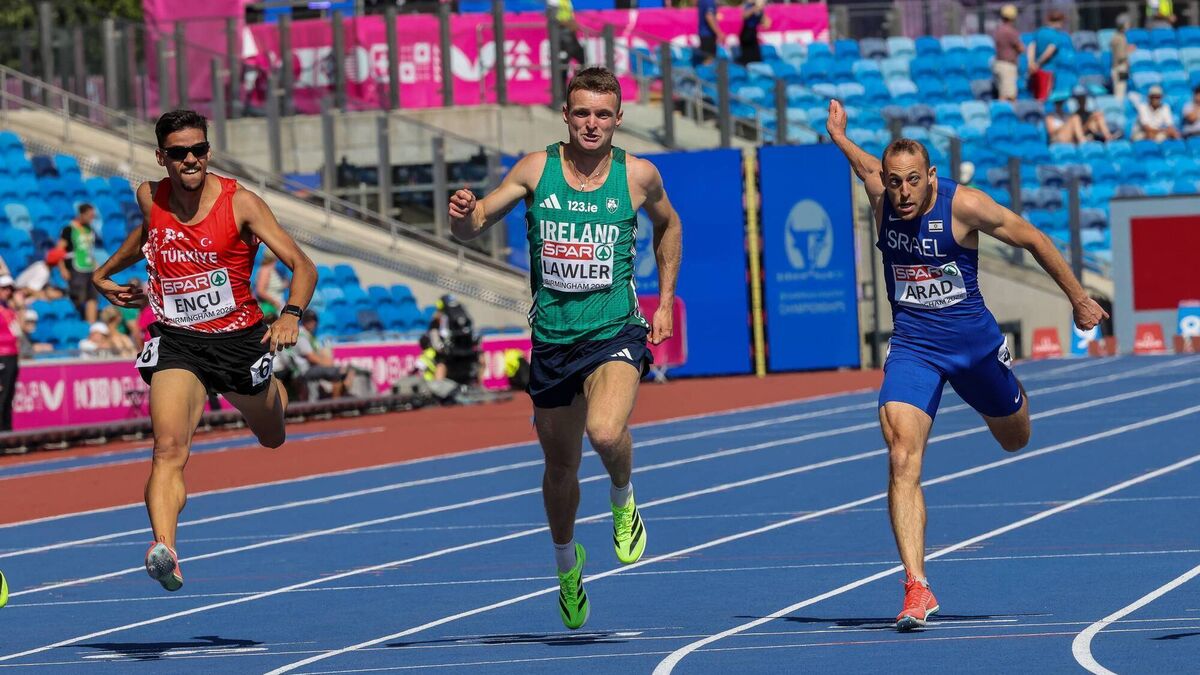
Marcus Lawler competing in the 200m at the European Championships in Birmingham.
It has been an incredible week for Irish athletics at the European Track and Field Championships in Birmingham.
A team of 49 athletes were selected to represent Ireland, the largest ever. Amongst them two Carlow athletes; Marcus Lawler and Molly Scott. Lawler competed in both the 200m and 4x100m relay while Scott was selected as part of the ladies 4x100m relay.
It was not only the largest team Athletics Ireland sent to the championships, it was also the largest ever medal haul – the increased investment into Athletics nationally clearly starting to yield the dividends.
Shrouded in superb sunshine each morning and evening, Alexander Stadium in the North of the city played host to a very large contingent of Irish supporters. Whose support was uplifting, reassuring and a positive force on the Irish team throughout their championship journey.
The stadium which has a capacity of 23,000 was said to have contained over 5,000 Irish supporters on any given night. In recent years thanks in no small part to Seamus Carey and his organisation “The Irish Supporters Club” Irish fans have travelled in groups across the globe, bringing noise, support and a general good vibe to each competition.
All the athletes competing including Carlow’s own suggested the support was unrivalled across all 50 European nations competing over the seven days of the championships.
Ireland’s four medals (two gold, a silver and bronze) have been well narrated across the media at this stage. However, each athlete’s journey through these championships has been applauded and cheered as if it were their own gold medals.
Marcus Lawler came into these championships expected his heat to be his final. In an interview with the Carlow Nationalist last week, he suggested he would have to run his heat as though it were is final and realistically some of those running low 20 second times may not even qualify.
Lawler lined up in heat 2 of the 200m last Thursday morning – a morning that saw temperatures soar to 37 degrees within the stadium. His personal best of 20.40 seconds ranked him well. While a recent injury sustained during his race in Norway did inhibit his training somewhat, his performance at training over the past ten days suggested a bit more optimism.
New rules mean that it is the top 13 overall ranked athletes from the three heats qualify for the semi-finals where those athletes will be joined by a number of athletes who have top world ranking position.
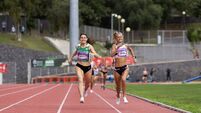
Drawn in lane 5, Lawler got off to a terrific start, the bend went well and by the time he came to the top of the home straight he knew he was within striking distance of a position. An excellent final 100m, saw Lawler finish fifth in 20.94 seconds, ahead of athletes who ranked higher than him in Europe.
Clearly exhausted and drained from both effort and heat, Lawler anxiously waited on the steps leading to the track – as he drowned himself with bottles of water, to keep his body cool.
Once all the heats were completed Lawler finished 11th out of the 13 athletes who made it through to the semi-finals. A punch of “yes” to the air expressed the relief and joy simultaneously. Behind every great man is an even greater woman and shouting on from the stands was his mother and coach Patricia (Almond), herself a European participant in her day.
Marcus and his family, wife Muireann and co-athletes from his training group based at St Laurence O’Tooles were out in force with their support.
The evening semi-finals were a quick turn-around. The heat of the day something all the athletes had to contend with. It was exhausting. Lawler lined up in Semi-Final 2, the fastest of the three races. It was not the race Lawler had imagined it to be.
But then he only had eight hours to imagine it as there was never an expectation to make the semi-final. The winner of that semi-final was Zarnel Hughes who eventually went on to win silver.
As Marcus walked off the track disappointed in himself, he had no need to be – he earned a place in the semi-final, progression and something to build upon.
Amid a few days where Ireland secured four medals, the Irish 4x100m relay teams were making a little bit of their own history. Very much having played second fiddle to the 4x400m Irish teams, these championships changed that perspective. The ladies 4x400m team who had high hopes of a medal, were decimated in the last two weeks with injuries sustained from their top two athletes Sharlene Mawdsley (Irish number 1 this year) and Rachel McCann (the national champion).
On Friday the ladies lined out first. The team included Lucy-Mae Sleaman, Ciara Neville, Sarah Leahy, Lauren Roy and Carlow’s Molly Scott. Speaking last week in an interview with the Nationalists Scott was as of then unsure who the competing quartet would be. Training, living and hanging out with the team, all those selected were given the same opportunities.
Unfortunately for Molly, despite her third place finish at the nationals, she was not on the named team for the actual race. It does not in any way diminish her performances this year. Relays are technical and consist of many elements from speed, baton changing, different positions within the team (bends v straights) all with their own nuisances. The team finished fourth in their heat and qualified for the final as the eights fastest rank, setting a new national record.
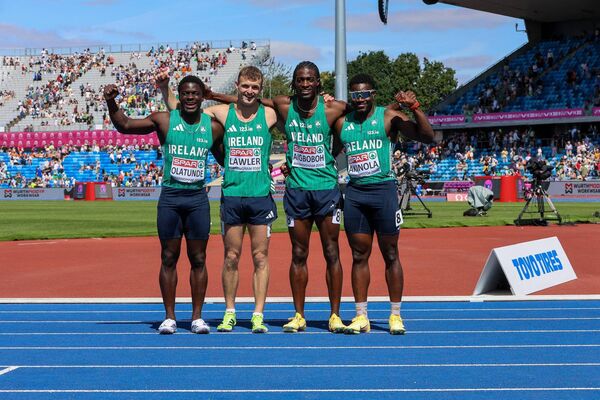
If the ladies could do it, then so could the boys. An atmosphere of excitement was building within the stadium as Bori Akinowla stood on the starting blocks ready to pass the baton to Sean Aigaboboh, then to Marcus Lawler with Israel Olatundu taking the baton home the final 100m.
The gun was fired, Bori ran a perfect bend with a perfect baton change to the youthful Aigaboboh. Marcus Lawler received and gave excellent baton changes and had the team up to fourth place.
Olatundu continued the momentum with Team Ireland finishing 4th in heat 2 in a season’s best of 39.13 and 6th fastest overall from both heats. The final was looking good.
Unfortunately, a poor first baton change eliminated any chance the team had to improve. But what ensured was a clear demonstration of leadership from Lawler who at 31 was the eldest member of the team.
Lawler immediately dispelled any self-blaming from the two athletes in question. He rallied the team together and faced the supporters as a team, worthy of their appearance in a European final. Two Irish 4x100m relay teams had made a European final, the first time ever in our history. Carlow was the only county that was represented in both teams.
What can we say of the Irish team’s performance? It has been the best ever. A fantastic gold from Mark English marks his sixth European medal, 12 years on from his first. More importantly it ends years of waiting and wanting that gold. A gold he always knew was within his reach.
His semi-final win in a new European Championship record of 1:43.49 - broke the 48 year old European Record, previously set by Olaf Bayer (East Germany) in 1978. English did not disappoint in the final. A well judged race where he laid on the speed over the final 100m was unmatched by any other athlete. He had the gold.
Rashidat Adeleke too had her break-through moment. Since her 4th place at the Paris Olympics after a glittering year, things had not gone well for the Dublin athlete. Below par performances, withdrawals from Diamond Leagues – all led to lack of confidence.
More importantly she did not have any qualification mark for the European Championships in the 400m, a race she got silver in two years ago in Rome. That changed with the national championships where she dropped down to 200m, became national champion and achieved the A qualifying standard for the Europeans.
Adeleke ran the perfect race, perhaps running out of track towards the end as she comfortably passed her old training partner from Texas Dina Asher-Smith before closing in on Amy Hunt. Just a few more meters, the gold might have been her’s. Gratitude.
That is how Adeleke expressed her feelings in the aftermath of the race. Gratitude for being at the championships, for earning a medal and for the support from the Irish in the stands. Her sliver 200m medal will possibly rank her most valuable medal to date, as it marks a turning point in what has been difficult two years.
Then came the gold medal from Kate O’Connor. Most expected a medal. Some hoped for gold. None more so than O’Connor herself. But there was the Olympic bronze medalists to get passed first. Season’s best, personal bests – O’Connor worked through them all and came out with a gold medal after her 800m performance.
With emotions visibly written on her face, she received her gold medal and like English in the days before, witnessed the Irish crowd greet her with pride and excitement. Like English, there were selfies and more selfies, autographs, handshakes and more. Ireland had their second gold medal. Not long after Andrew Coscoran surprised many with his third place finish in the 1500m final and his first ever major championship medal. It was a night of wild excitement.
A lot has been said about the Irish supporters throughout the week. Within the stadium Geoff Wightman, the commentator, was beginning to feel Irish himself. The green, white and gold was displayed at every available space.
It was like home from home, so many of the familiar athletics faces were present. The Forde’s from Barrow Valley, Scott’s, Lawlers and a host of others from St Laurence O’Tooles, Cullens from St Pats (Tullow).
Every day some new Carlow supporter popped up. Both Marcus and Molly will long remember these European Championships as the ones, where Irish support drove the agenda and they as athletes were part of a new wave of Irish athletes punching their weight in European Athletics.