Irish football folklore at Dublin Film Festival
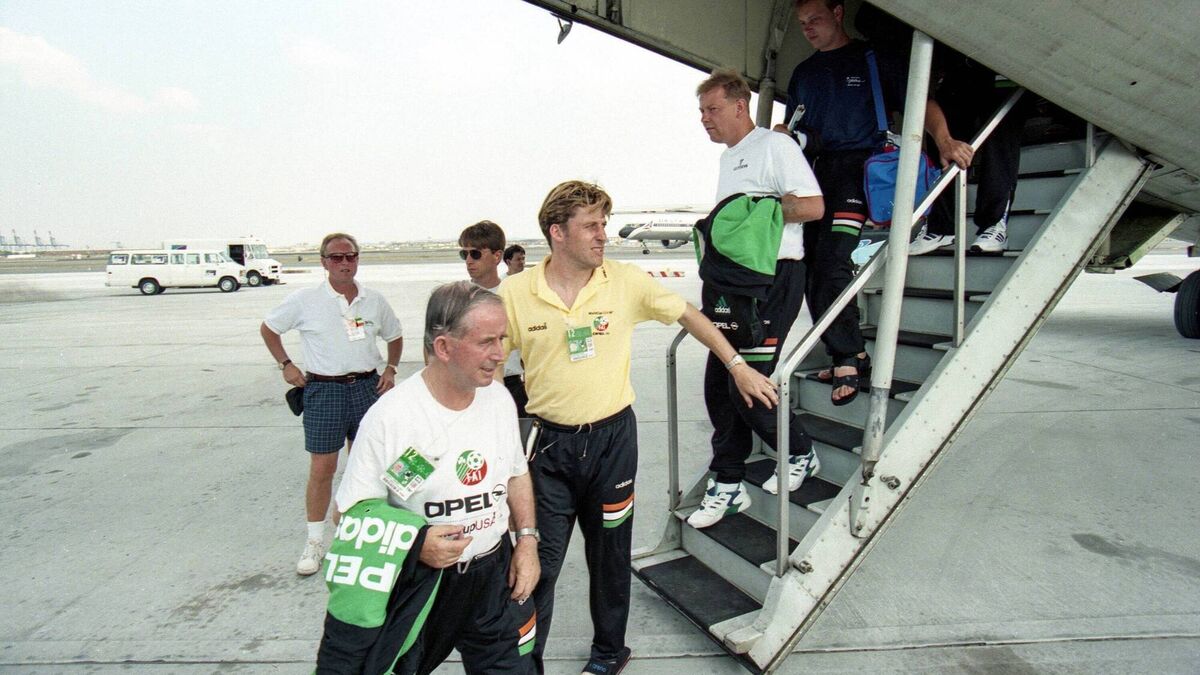
Andy Townsend follows Charlie O'Leary off the plane as Ireland arrive for USA '94. Photo: INPHO/Billy Stickland.
The Covid19 Pandemic had numerous unforeseen fallouts. People began to embrace remote working, some found a new perspective on what is truly important in their lives, while many others used the situation to change careers.
One such career move saw Ardattin man Fergus Dowd transition from IT Systems Analyst to a multi-award-winning film producer. Having formed a flourishing partnership with Dublin director, Joe Lee, the pair have now produced their third film together, this time exploring the life Irish football royalty.
'The Charlie O'Leary Story - From Johnny Cullen's Hill to The Olympic Stadium Rome' premieres at the Light House cinema tonight (February, 24th) as part of the Dublin International Film Festival.
“I sort of fell into filmmaking during Covid, because I'm actually an IT Systems Analyst by trade,” Dowd told The Nationalist. “We did a film on the Debenhams Strike back in 2023, ‘406 Days’, that was filmed during Covid. It won Best Irish Documentary, a Human Rights Award and an Audience Award.”
In December 2022, shortly before releasing ‘406 Days’, Dowd and Lee began working on their second project – a film commemorating the 50th anniversary of the Dublin-Monaghan bombings – which was released in 2024.
One of the people interviewed for the film was Derek Byrne, who was working as a petrol pump attendant on Parnell Street when the explosions took place in 1974. On the day of the bombing, the 14-year-old Byrne had brought his football boots to work he was set to go to London for a trial with Tottenham Hotspur.
Sadly, he was caught up in the bombings and taken to hospital where he was pronounced dead. Remarkably, however, Byrne woke up in the morgue seven hours later and was returned to the hospital for life-saving surgery.
It was their interview with Byrne that led the filmmakers to investigate the legendary Charlie O’Leary.
“When we were interviewing Derek, he was just mad into football and,” Dowd said. “He told us he got started played in a thing called the Street Leagues, which was played in Gloucester Diamond in the North Inner City.
“We didn't know what the Street Leagues were, myself and Joe, and so we sort of put that on the back burner and thought that might be an interesting project to try and find out more about.”
Enter Joe Moran; a renowned sculptor who had previously worked with Dowd.
“I was chairman of the Patrick O'Connell Memorial Fund a number of years ago,” Dowd said. “Patrick's a former Irish footballer. He died penniless in London and was in an unmarked grave for 57 years.
“He was the first Irishman to captain Manchester United. He’s the only Irish manager to win La Liga – he won it with Real Betis. He also managed Barcelona and saved them during the Spanish Civil War when he took them on a tour to Mexico.”
During a project for the Memorial Fund, Moran sculpted a bust of O'Connell, which is now on display in the Real Betis Museum. The sculptor was familiar with the Street Leagues and urged Dowd to get in touch with the legendary Charlie O’Leary, who had established the leagues in 1945 when he was just a teenager.
Teams were formed based on the streets where people lived, beginning in Dublin but eventually spreading to urban centres across the country, with iconic players such as Johnny Giles, Tony Dunne, Liam Touhy and more coming through the system.
“Charlie was 100 years of age when we went to interview him, that was in the summer of 2024, and his memory is just unbelievable,” Dowd told The Nationalist. “His knowledge of Dublin, of football, just incredible for somebody of that age. We ended up doing a four-hour interview with him. And so, the street league story, instead of being the main story, became part of Charlie's life story.”
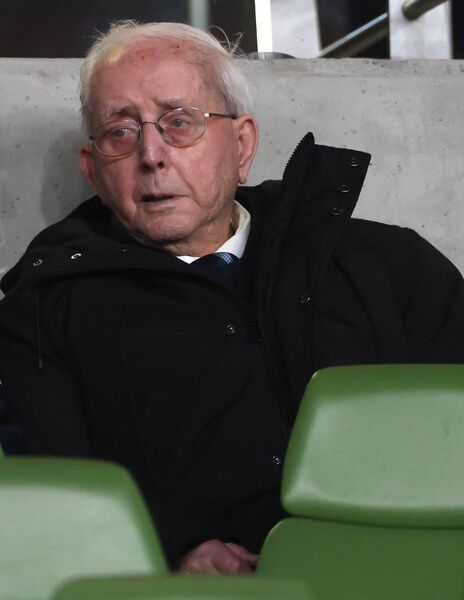
'The Charlie O'Leary Story - From Johnny Cullen's Hill to The Olympic Stadium Rome' recounts the many twists in O’Leary’s fascinating tale.
He earned a living working in the Eastwall Sawmills from 1938 until 1980, while carving out a niche for himself in the world of football. Having set up the street leagues in 1945, O’Leary went on to become a referee, starting out in the Junior Leagues in 1959.
He was soon elevated to the League of Ireland, where he spent two decades as a well-known referee, and became one of the first FIFA-affiliated Irish referees. He was the man in the middle for numerous club and international games right across Europe throughout the 1960’s and early ‘70’s.
O’Leary took charge of top-flight games in England and Spain, refereeing Barcelona at the Nou Camp and travelling beyond the Iron Curtain for international matches in East Germany and elsewhere.
He is the only referee to officiate Irish Junior, Intermediate, Senior and National finals, and the last match he took charge of was the 1972 FAI Cup Final, which, fittingly, was the very first soccer cup final televised on RTÉ.
When the sawmills closed in 1980, O’Leary went on to work in the Department of Communications before taking a position with the FAI, looking after the away teams that came to Dublin.
He welcomed Paolo Rossi’s World Cup-winning Italy side in 1985, and a year later was on hand when a Welsh team that included Ian Rush, Mark Hughes and Neville Southall came to Lansdowne Road for Jack Charlton’s first game in charge of Ireland.
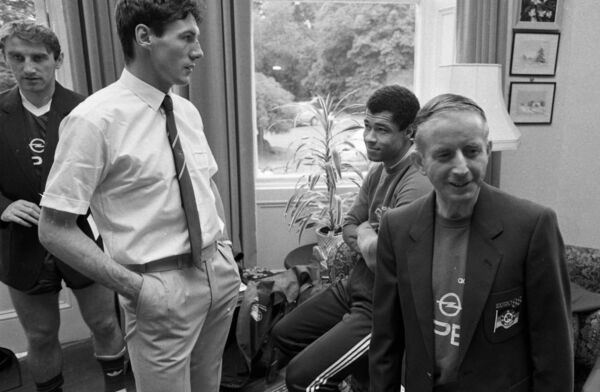
As it happens, O’Leary had twice refereed Leeds United when Charlton played alongside names such as Johnny Giles, Billy Bremner Norman Hunter, and Eddie Grey under the watchful eye of Don Revie. Charlton remembered O’Leary and invited him into the Irish set-up, where he would go on to be almost as iconic as Big Jack himself.
The forever famous diminutive kitman is front and centre for all the iconic moments in Irish soccer at a time when we were genuinely at the top table of the sport. Arm-in-arm on the Stuttgart pitch with Ray Houghton after the Euro ‘88 win over England. Racing towards Packie Bonner to celebrate the Italia ’90 penalty shoot-out win over Romania. Gazing in awe at Pope John Paul II before the quarter-finals. Embroiled in the centre of the John Aldridge incident against Mexico at USA ’94. O’Leary saw it all.
“After you sit down with Charlie, you come out to the car with your equipment and you're sitting there and you're thinking, oh, my God, this is it, you know, suddenly, we have a story here,” Dowd explains.
“It grew organically, from nearly a community project interview about the Street Leagues to a film that now, the Lord Mayor of Dublin has chosen it to be his film for the festival.”