Scott and Lawler carry local pride to European Stage
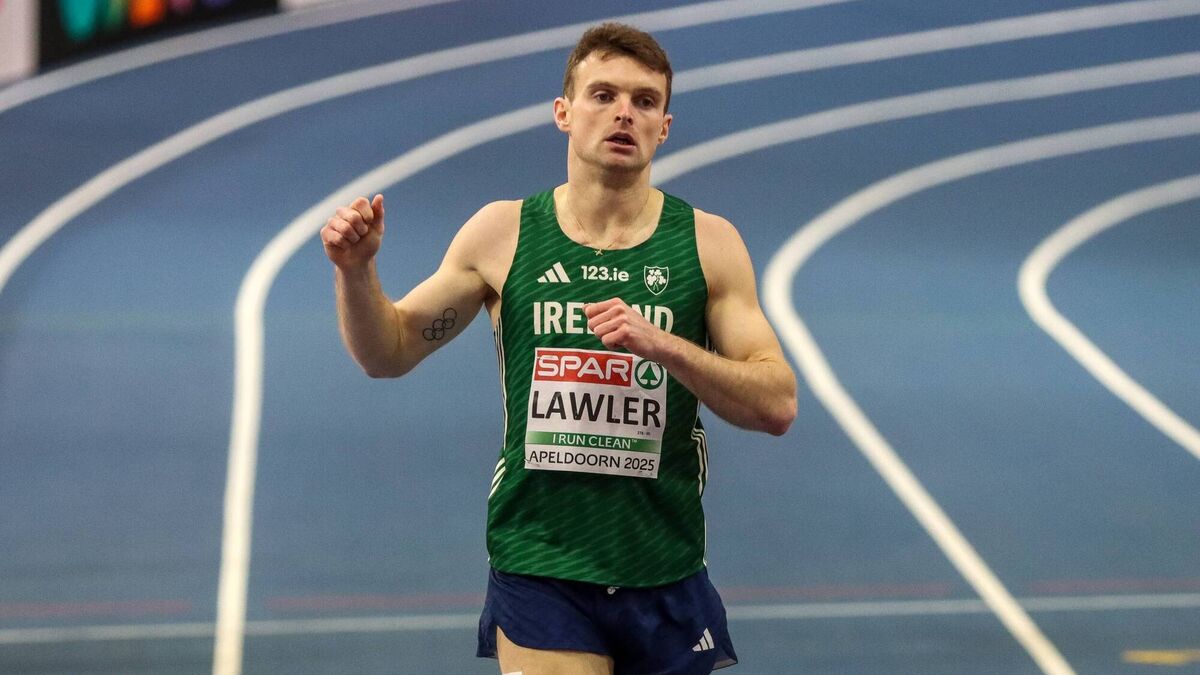
Marcus Lawler of the Ireland men’s 200m and 4x100m relay teams.
As the European Athletics Championships approaches, two familiar names from Carlow are preparing to take their place among the continent’s elite. Molly Scott and Marcus Lawler, both forged through years of success, persistence and setbacks with tacit fortitude, to don the Irish vest once again—Scott in the women’s 4x100m relay, Lawler in both the men’s 200m and 4x100m relay.
For a county that continues to punch above its weight in athletics, their selection is more than a personal milestone. It is a reflection of years of unseen work, of early mornings and late nights, of injuries endured and sacrifices made. And perhaps most importantly, it is a story of evolution—of two athletes who have learned to redefine what success means.
Coincidently, there is a marked similarity between both athletes. Each is coached by their respective mothers, both have entered a new phase of their lives, one that demands them to balance work with their athletics. Both have had injury setbacks where with an element of stoic equanimity to achieve fitness for the forthcoming European Championships they have persevered and been rewarded with selection.
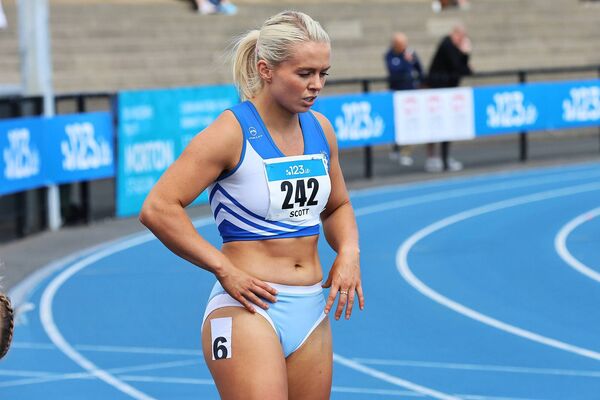
For Molly Scott, the road to Birmingham has been anything but straightforward. Her season’s best of 11.55 seconds in the 100m hints at a return to form (she ran 11.64 last weekend in London).
There was a personal best last September in Copenhagen – 11.41 seconds, a surprise given how her season had gone. Numbers alone cannot capture the journey that brought her here. A successful juvenile career had translated into a bronze medal at the European u18 100m hurdles in 2016.
A European silver followed in 2010 when she was part of the 4x100m relay team. She chased times, chased dreams “5 feet 3 tall with 10 feet of dreams” she wrote back in 2022. There were dreams. She had made the relay squad for Berlin back in 2016 and did not get to run. 2022 was going to change everything. She had qualified for the 100m individually and she was on the relay panel for the European’s in Munich. She had hopes of making the Paris Olympics.
“Making the Olympics is the pinnacle,” she says, a statement that reflects both ambition and perspective. Because for Scott, the past number of years have been less about chasing times and more about simply being able to run again.
Four years ago, her career hung in the balance. A devastating injury—a 17cm longitudinal tear through the posterior tibial tendon under her ankle and into her foot—left her facing a reality few athletes are prepared for.
“Based on the scan, I shouldn’t even have been able to walk,” she recalls. “And suddenly you go from feeling like you have everything to not being able to walk down the stairs.”
That came at a period when the St Laurence O’Toole athlete was in the form of her life. A national record in the 60m followed with selection for the European indoor championships and by summer she had qualified individually for the 100m and was on the relay squad.
The injury was rare, serious, and isolating. Recovery was not measured in weeks or even months, but in years. For six months, Scott aqua-jogged every second day. For seven months, she couldn’t jog at all. Progress was painstakingly slow—an incremental return that required constant monitoring, patience, and a willingness to accept uncertainty. She never gave up. Pain was measured in scales to determine her exercise regime.
“You’re always balancing—knowing when to push and when to pull back,” she explains. “We had a pain scale. If it got to three or four, we stopped. But there were times you had to push through that fear too.”
There was no blueprint to follow, no obvious roadmap to recovery. Instead, Scott found inspiration in others—athletes who had endured similar battles and emerged stronger.
“People like Ciara Neville, leading New York ballerina Candy Tong, (who she discovered had sustained a similar injury).… seeing what they went through and how they came back—it gave me belief. Deep down, you feel you can come back better. Something keeps you ticking over.”
If the physical recovery was gruelling, the psychological transformation was just as profound. Scott openly reflects on how her relationship with athletics has changed. Once driven primarily by winning, by validation and results, she now approaches the sport with a different mindset.
“I used to be very results-driven. I was in it to win,” she says. “But after everything that happened, I started asking myself—am I doing this because I enjoy it, or just because I’m winning?” The answer reshaped her outlook entirely.
“I enjoy athletics so much more now. It’s less intense. It’s more about me versus me—running fast because I love that feeling.”
There was a time when failure would have been unthinkable. Now, it has become a teacher. “All the failing taught me—why am I doing this? It made me more resilient. I don’t think about ‘what if the injury never happened’ anymore. It was supposed to happen.”
That shift—from external validation to internal fulfilment—has been key in her return.
These days Scott’s story is not just about athletic perseverance and spending her life chasing athletics goals. Questioning her rational for competing during the period of injury she decided that she needed her career just as much as she needed her athletics.
Her life had to go on and not leave her empty handed when her athletics days were over. Now she has to balance her dual careers of athletics and law at an elite level.
She sat the bar and passed - a qualified barrister—a demanding profession that requires long hours, intense focus, and constant pressure. In Ireland becoming a barrister is not financially lucrative in the early years.
“There is a concept called devilling, where you are the devil and you get a master. As such you are self-employed. The hours I spend on the track are the hours many of my colleagues are working a second job to earn enough to live in Dublin” she said.
So what does it feel like to be working, especially when you have had time off injured? “It felt like the start of a race every day going into court,” she says.
“That adrenaline, that cortisol spike—you’re getting it constantly.” The combination of full-time legal work and elite training proved to be a difficult balance at first. Early mornings, long commutes from Carlow to Dublin, late evenings on the track—it was a relentless schedule. “I was up at 6am, a 30 min drive from home to catch the train from Carlow to Dublin, a Luas, and then in court all day, then straight to training. It was exhausting”.
Her mother and coach Deirdre would take her to the track for a session and it was often around 10pm when they got home in that first year. With little time to focus properly on recovery and nutrition, “it was a recipe for disaster.”
The result was fatigue that, in her own words, was “harder to get over than the tendon injury.” It forced another recalibration. “You realise you can’t push every boundary. There’s a limit to your battery. Now it’s about managing that better.”
Even now, the balance is delicate. Court deadlines can run late into the night. Training sessions often follow long workdays. Sleep and recovery are sometimes compromised. But compared to a year ago, she sees progress. This has helped to a large extent by a move to Dublin, avoiding the long commutes.
“It’s still tough, but it’s better. I’m starting to feel normal again.”
This level of normality could not have been achieved without the support of her mother Deirdre who is also her coach. Their relationship is unique, blending the personal and the professional. “We get on really well, but it is unusual,” she says. “Sometimes we’re more athlete and coach than mother and daughter.”
Yet it is a partnership built on trust, shared passion, and mutual understanding. From early sessions under floodlights powered by a generator, to international competitions, their journey has been intertwined from the beginning. “We’ve had so many experiences together. It’s brought us closer.”
Deirdre Scott now travels several times a week to Dublin to be there on the track to coach her daughter. Molly is aware of the sacrifices her mother has made to enable her to achieve more balance and never once takes it for granted. Her support is paramount.
That sense of support extends beyond family—to training partners, friends, and colleagues in the legal profession. With all that focus on work and athletics is there room for a social life?
“It is all about balance and the bar is my social life,” she says. “It’s very collegiate—coffees, dinners, great people. That fills my social cup.”
As Scott prepares for the European Championships, her approach is pragmatic. There is no grand declaration of intent, no bold predictions. Instead, there is quiet confidence. “I’m just looking forward to being part of the team, contributing where I can.” The legal term has ended and she has a rare opportunity to rest and focus fully on racing—a luxury she hasn’t often enjoyed.
And beyond this championship, her ambitions remain clear: “2027—European Indoors in the 60m. Run PBs. Keep improving.” And what about the hurdles, a discipline she still loves and continues to train for? “If I drop the hurdles, my sprinting gets worse. So I’m still working through some technical bits.” For now, though, the focus remains firmly on the relay—and on embracing the moment.
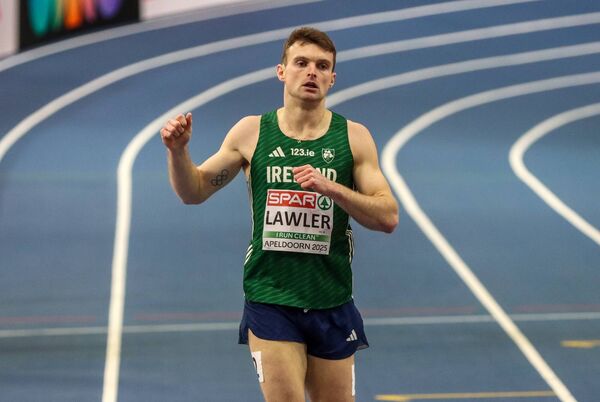
Like Scott, Marcus Lawler had enjoyed a successful career in athletics. It became the focus of his life, the driver of life decisions. It was a family affair, coached by his mother Patricia who as Patricia Almond was herself a successful athlete; winning national championships, competing internationally for years including majors such as the European’s.
Lawler had won nationals, was a world university games bronze medallist over 200m back in 2019 and was all set to pursue a successful senior athletics career. Like Scott, injury interjected. He bounced back and then injury again. A cycle that seemed impossible to break.
The National Indoors in 2025 marked a breakthrough for Lawler. The Tinryland native ran 20.74 for 200m, a new personal best and his first indoor gold in over nine years. The two and a half year drought from being on Irish teams had ended.
He was selected for his first ever European Indoors and for the first time ever was selected for the mixed 4x400m relay. That all came on the back of nearly three years of frustration, injuries and just not hitting the marks he had planned to do. Others would have given up during that period, Lawler did not. Self-belief, the love of the sport, always working through everything with the end goal in mind.
Yet after the success that 2025 had brought he found himself back in 2026 bouncing between improvements and injury. After missing the national indoors through injury he found himself running fast times by May.
More improvements in June after a good run in Belgium, London and then in Spain. He found himself within the rankings quota for the Europeans. Then injury struck. It improved and he raced to get fit again.
For Marcus Lawler, selection for the European Championships brings a mix of relief and excitement. “Obviously delighted,” he says. “But also relieved. Injuries came into the frame this year.” At one point, his place in the 200m looked uncertain. A strong trajectory early in the season had positioned him well, but a groin injury in Norway disrupted his plans at a critical time.
“About 60 metres into the race, I felt it go. It was a three-to-four-week injury, and I missed key races.”
Those missed race opportunities had a knock-on effect on rankings—an increasingly important factor in qualification. “It’s a tough system. You can be in great shape, but if you don’t get into the right races, your ranking suffers.”
In 2025 after his gold at the National Indoors on the day of his 30th birthday, someone remarked about his age. “Age does not define me” Lawler said back then. His stance is still the same. Now 31, Lawler is acutely aware of the need to adapt. His training is no longer about pushing maximum volume, but about precision and longevity.
“Five years ago, we might have done eight or nine reps. Now it’s six. Sometimes even less,” he explains. “You learn to listen to your body.” It’s an insight into the kind of judgement that prolongs an athletes life. Injuries happen so much more easily as the body goes through years of pounding. Thus managing those injuries becomes paramount. This year, his ongoing Achilles issue has required careful management, particularly after the indoor season.
“It’s something I have to stay on top of—monitoring volume, limiting plyometrics, making sure I don’t overload.” The adjustments have been necessary—and effective. He is back on track and back in an Irish vest. “I feel fully healthy now, racing in the Europeans. That’s the main thing.”
Like Scott, Lawler is also balancing a professional career alongside elite athletics. In his role as Regional Development Officer for Carlow, Kilkenny, and SETU, he works to grow athletics at grassroots level—while maintaining his own training schedule.
“It’s flexible, which helps,” he says. “And I’ve great support from the people I report to.” The role offers a unique perspective—bridging elite performance and community development.
“You see the impact of success. Kids come to camps knowing who you are, wanting to join clubs. The Olympic performances in recent years have really inspired people.” He is particularly passionate about retaining athletes during the transition to college—a period where many drop out. “It’s a tricky time. Results might dip, but if they stick with it, that’s when the improvements come.”
For Lawler, performance is as much about mindset as it is about physical preparation. “Tension is the enemy,” he says. “To perform at your best, you need to relax.” It is a philosophy he has embraced more deeply with experience. He has learned to focus on enjoying the sport more, being less intense. Being grateful for the opportunities that come his way and how intensity kills enjoyment and ultimately destroys success.
“Run with freedom. Smile. Enjoy it. That’s when I perform best.”
At the European Championships, he is realistic about the challenge ahead. “The heat is effectively my final,” he says. “The standard is so high—guys running low 20s might not even make the final.” Yet there is no sense of pressure—only opportunity. “It’s a free swing. Just go out, execute, and enjoy it.”
While athletics is often seen as an individual sport, Lawler is quick to highlight the importance of those around him. Something Molly Scott has also pointed out. The parallels are there again.
From his coach Patricia, to strength and conditioning support from Martina McCarthy, to training partners and his wife Muireann—his journey has been a collective effort. “You need a team around you. We plan together, we commit together.”
While the training plan may have been written in advance, it is often rewritten at the track, mother and son focusing on the current. Their coaching relationship has been decades long, Patricia knows when things such change and often that can be mid-session.
“Patricia is at every session, always has been” said Lawler. “Except last Sunday when she went to the Dublin to support the Carlow ladies Gaelic Football team” he smiles. His sister Grace was part of the panel.
It is not always just Marcus and his mother. Others join in too. Adam Murphy when he is back home, Sive O’Toole, Shane Webb, Joe Burke whoever is around really. There is also a strong sense of community within his training group—an environment that fosters both competition and camaraderie. “We push each other, but we get on well. That’s important.”
In addition to the individual 200m, Lawler is part of the Irish 4x100m relay squad—a discipline that brings its own unique challenges. “It’s not just about showing up on the day,” he says.
“It’s very technical. You need time together.” Relay camps and training sessions are crucial, but scheduling can make preparation difficult. “Everyone has different competition schedules. You can lose momentum.”
Despite that, he relishes the team aspect. “There’s nothing like being part of a relay team—representing your country together.”
As the European Championships approached, most people would be winding down.
“Because of the injury I still feel I am on the wind up and sharpen the blades. Normally it would be a 10 day taper. I still need to do a few key sessions. I am minus a race which means I will do some sort of time trial at training”.
Lawler was enjoying the run in to the championships, decreasing tension and building up the enjoyment factor he spoke about earlier. Is he nervous? “It’s almost more excitement rather than nerves. A borderline giddiness about it. I am looking forward to it”.
As much as the training plan is important the positive mental focus and environment being in place is a big factor. “I think the big stadium factor gives you that wow. You hear the roar and look up, see the support and you are in the Irish vest” he pauses wistfully, “… this all helps.
“Amsterdam in 2016 was the first time I was on a European relay for senior. In 2022 in Munch I was in the stand (Lawler ran the 200m). I pulled my groin for Rome, two years ago”.
He raced the European indoor 4x400m mixed. He won’t know his relay fate for Birmingham until this week.
At 31, Lawler is entering a new phase of his career—but he is far from finished. “I’ll keep going as long as the times are moving in the right direction,” he says. He points to athletes like Mark English as inspiration—proof that peak performance can come later. “I only ran my 100m PB in 2025. There’s still room to improve.” For Lawler, the motivation remains simple.
“I just want to see how good I can get.” Marcus Lawler will race the individual 200m on Thursday morning at 11.05am. The ladies and men’s 4x100m relay preliminary rounds will take place on Saturday at 12.40.