Chasing Ladybirds - A Review
Renowned golf writer Dermot Gilleece has a new book out
This time last year when Dermot Gilleece penned his book A Farewell to the Fairways the feeling was that this was the final swan song for the renowned golf writer and journalist. Even the title of the work had an air of finality about it. So out of nowhere, one of Ireland’s most well-known sports writers has produced what is surely one of the most important and most interesting books that has ever been written about Irish golf.
His latest work, Chasing Ladybirds-How Irish Players Scaled Golf’s Summit is a definitive record of the history of Irish golfers who played in the British Open. There is a bit more to it too as Gilleece goes deeper into the world of golf. His account of Jean Van de Veldt’s meltdown at Carnoustie in 1999 is vivid where the Frenchman needed a double bogey six on the last hole to become champion but carded a seven.
So why did the writer pick up his pen once more?
“I thought to myself that with The Open in Royal Portrush this year, it would be my last opportunity to go. That really prompted me to think about a book about Irish Players in The British Open,” revealed Dermot.
Having retired he had to explain why he needed media accreditation.
“I wasn’t attached to any newspaper. I explained that I was doing a book and that this would be my 40th Open.”
The writer takes the reader back to the 1913 Open when Michael Moran of Royal Dublin shared third place with Harry Vardon at Royal Hoylake. Sadly Moran, who joined the British Army, was killed in The Battle of the Lys in World War 1 and was laid to rest in what would eventually be called Le Cateau Military Cemetery in the North of France.
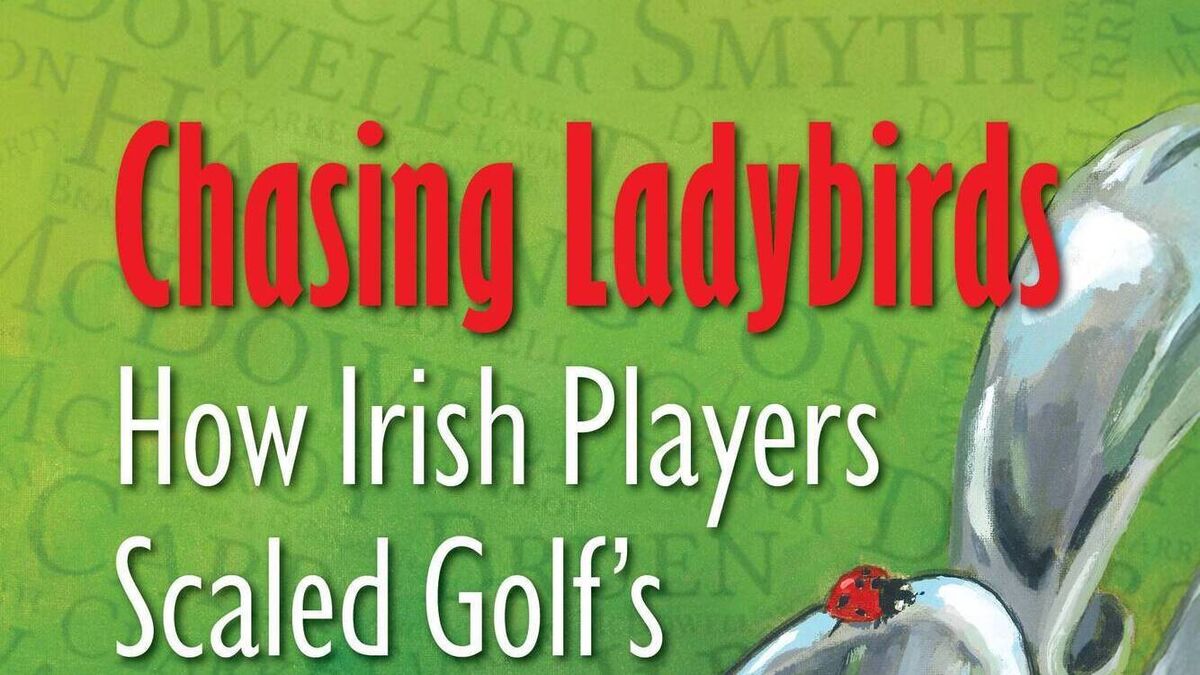
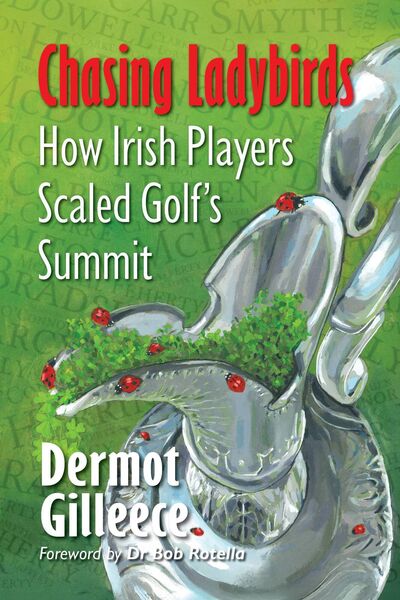
The title of the book speaks for itself. Who will ever forget a three-year old Paddy Harrington running out into the arms of his father after Padraig had finished the 18th hole in 2007 at Carnoustie. It was an iconic moment in Irish sport where Padraig was able to put aside his disappointing finish and mentally prepare himself for a play-off against Sergio Garcia which saw him emerge triumphant. Young Paddy will always be remembered as the little boy who wanted to put ladybirds in the British Open trophy. Thence the cover and the image of ladybirds on the trophy. The Gilleece family later commissioned an artist to do a replicate painting of the cover of the book which was presented to the Harrington family.
The book also delves into amateur golf where golf coach, Neil Manchip, was enthralled by the sweet striking of a young Shane Lowry.
In the chapter, When Irish Golfers Made Their Mark, Gilleece recalls Jimmy Bruen cementing his place on the 1938 British and Irish Walker Cup team by shooting a total of 282 in four trial rounds at St Andrews. Bruen would eventually lead the side to an historic 6-3 win over the United States at the St Andrews course in Brookline. Much of the writers research on Bruen was done with another Irish golfing legend, Joe Carr.
The writer also recalls the feat of Paul Dunne who led the 2015 British Open at St Andrews before the then amateur fell away to finish in 30th place. Dunne would eventually turn professional and Gilleece throws in a timely reminder that he won the 2017 British Masters holding off the late challenge of Rory McIlroy.
If Jean Van de Veldt’s loss will never be forgotten then Gilleece suggests Doug Sander’s two foot missed putt at St Andrews is equally tragic. While he doesn’t go into detail about Saunders disappointment almost a full chapter is devoted to the Frenchman’s loss but perhaps more significantly the writer reminds the reader that Paul Lawrie, the eventual winner, went into the week full of confidence. While the Scot felt he was too far back on the last day, when the chance came in the play-off, he took it with both hands. Justin Leonard, who won The Open in Royal Troon two years earlier was also involved in that play-off.
Ther is an entire chapter devoted to the career of Fred Daly who became the first Irish golfer to win The Open. He did so at Royal Liverpool Golf Club when he edged out Frank Stranahan from Toledo and Reg Home. Gilleece recalled that Daly sat in the bar listening to the wind howling outside with Stranahan needing an eagle to tie. Gilleece writes in his book that the second last shot, a 120 yard effort by Daly’s pursuer ended up ended up no more than three inches to the right of the hole.
Then there was the story of Harry Bradshaw’s ball ending up in a Guinness bottle at Royal Sandwich at the 1949 Open. Bobby Locke beat Bradshaw in a 36 hole play-off but legend has it that the Irish golfer lost his chance to win outright because of the bottle incident.
In the book, there is a photograph of Bradshaw bending over a bottle with a ball in it but the golfer confided with Gilleece that this photo was actually posed for behind the professional shop in Royal St Georges.
“There was a lot of fiction written about that incident. I sat down with Harry in 1987. He was a great talker. He fictionalised, if that is the word, about what happened. It was a good story around the bar with friends in Portmarnock. Harry gilded the lily big time. When we got down to the facts I began to find a different story.” Gilleece does suggest Bradshaw’s ball may have landed on glass but whether it actually ended up inside a Guinness bottle then maybe that is pushing it.
Chasing Ladybirds is a timely reminder of the many great Irish golfers who have, in the past, performed so admirably all over the world.
Gilleece book recalls the heroics of Christy O’Connor senior who was second to Peter Thompson at Royal Lytham at St Annes in 1958 and tied second behind the Australian golfer in Royal Birkdale in 1965.
Christy O’Connor junior, was second to Johnny Miller at Royal Birkdale while Eamonn Darcy was fourth behind Ian Baker Finch at the same venue in 1991. In 1982 Des Smyth was tied fourth to Tom Watson in Royal Troon. All these and many more Irish golfers get honourable mention in the book. There are so many.
No doubt, Harrington’s feat in winning two British Opens in consecutive years 2007 and 2008 inspired a new generation of Irish golfers where Rory McIlroy, Darren Clarke and Shane Lowry have all gone on to win The Open. Graeme McDowell annexed the 2012 US Open. McIlroy is now only one of six golfers who have recorded career Grand Slams.
The big question is would Irish golfers have gone on and recorded such success if Harrington hadn’t led the way?
Gilleece says, the great golf psychologist, Bob Rotella, has no doubt that it would have been almost impossible for Irish golfers to have achieved what they did if Harrington hadn’t won in 2007.
“Bob (Rotella) described it as contagion. We often use that word when we describe the spread of a disease but Rotella has a great affection for Irish players. He likes them the way they are as people. Their general attitude to life and the game. He (Rotella) talked about the impact Padraig had on the players around him.
“It is self-belief. Padraig had that self-belief and never more so when his caddie talked him over at the finish of the infamous eighteenth hole in 2007. He still found that belief and the mental courage to see it out.” There is a chapter in the book dedicated to the late Eddie Jordan, the former motor-sport racing driver and team owner whose close friends included Tiger Woods and Nick Faldo. It is a fascinating insight into the relationship which Jordan had and the respect which Irish professional golfers had for him.
Now with the book on the shelves, Dermot Gilleece has done Irish golf some service.
Would he have given his right arm to have been in Augusta when Rory McIlroy finally achieved the Grand Slam of Golf.
The golf writer says no. He was happy to be where he was watching it from afar.
“I suppose I have now accepted that there is always going to be another tournament but my wife (Cathy) says to me that we have had a great life and we travelled the world together,” he says.
“Really I don’t have regrets. That is the truth. I was delighted for Rory. It was great for him to get that monkey off his back. Great to become one of only six players to win the modern Grand Slam. It was great that it happened but I was happy to look at that on television and take it in that way. He has given us so many wonderful memories. Rory is a good guy and creates the right kind of image which can only be good for golf down the road.”
Chasing Ladybirds How Irish Golfers Scaled Golf’s Summit By Dermot Gilleece. Foreword by Bob Rotella RS Red Stripe Press.