‘Enjoyment, enjoyment, enjoyment’
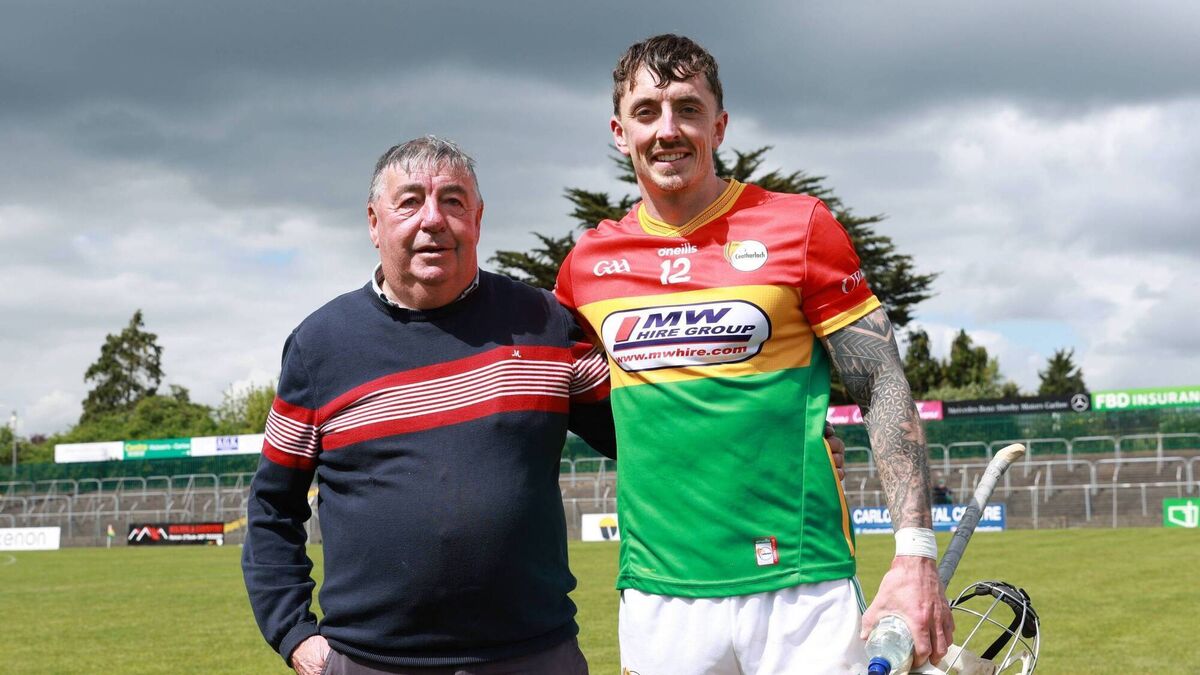
It was a special day for James Doyle who celebrated playing his 100th game for Carlow and is pictured with St Mullins and Carlow legend Mattie Kehoe, Carlow's first man to play 100 times for Carlow Photo: Pat Ahern
I came across those heartfelt words — spoken by the former Galway hurler PJ Molloy in a 2018 interview with Stephen Glennon of the Connacht Tribune — when researching a ‘Heroes of the Past’ piece on the Athenry clubman for the programme for next weekend’s Leinster SHC games.
With the ‘Heroes’ article goes a ‘Stat Attack’, taken from my comprehensive Flagship Hurlers project, which catalogues the career of every hurler who ever donned a county jersey in a competitive fixture. Molloy’s stats are impressive: 144 competitive appearances in the maroon and white, locating the net 41 times and raising 369 white flags. That’s a lot of enjoyment.
It was his ‘enjoyment, enjoyment, enjoyment’ emphasis that caught my attention, as I’m sure it echoed the thoughts of many a flagship hurler — men who played for love of county, yes; men who played for love of club, yes; but men who hurled for the pure love of the game too.
We in Carlow have been extremely lucky that we have had many, many men who, for many, many years, hurled for those three loves — the club, the county, the game. And on Saturday in Netwatch Cullen Park, James Doyle joined the ranks of men who have played 100 competitive games for Carlow’s flagship hurlers.
The St Mullins clubman is the 30th member of the elite ‘100 Club’. The first was another St Mullins clubman, Mattie Kehoe, an outstanding goalkeeper. Mattie was in attendance on Saturday to support his son Conor and the Carlow team as they clinched a place in the Joe McDonagh Cup final. Afterwards, Pat Ahern captured for posterity a shot of the first and the latest centurion together.
On a poignant note, there is a family connection. The late Rosie Kehoe (née Murphy), a great follower of St Mullins and Carlow hurling, was married to Mattie’s brother Pat, who also hurled with the county. Rosie’s sister Kathleen is James Doyle’s mother, and the late Rosie — whose 10th anniversary falls around this time — was James’s godmother.
The Kehoes, the Doyles and the Murphys will echo PJ Molloy’s sentiments about love of hurling and ‘enjoyment, enjoyment, enjoyment’.
As a teenager, I had started collating Carlow’s appearances, and it was Mattie’s reaching of 100 (he was presented with a Carlow jersey in the dressing room after the game) that inspired my Flagship Hurlers project and began decades of research — starting with Clare and eventually extending to all 32 counties as well as the Exile teams.
The reason for the ‘flagship’ title is that, apart from traditionally strong counties who have always been senior, every other county has experienced life at junior and/or intermediate levels — the predecessors of the current tiered system. Regardless of tier, every name on the database has played for the love of the game and derived great enjoyment from it.
The same goes for our Carlow footballers, whose ‘100 Club’ numbers 14 — Eoghan Ruth the latest entry last January.
And, you know, methinks our Gaelic games players have, unknowingly, been following those steps for 125 years.
“It is important in my model of happiness to have something that you enjoy doing. The challenge for a school is to find every child some kind of passion, something that will see them through the troughs. That’s why I’m in favour of the broadest curriculum you can get.” Well, in the schools and clubs of this country — of this county — a passion for Gaelic games was cultivated. Many became flagship hurlers and footballers.
“A leaf off a tree has the advantage that it floats about a bit, but it’s disconnected and it dies.” Our flagship hurlers and footballers have become members of teams — vibrant leaves on a tree.
“Number four: don’t resist change. Change is important. People who are fearful of change are rarely happy. I don’t mean catastrophic change, but enough to keep your life stimulated.
“People are wary of change, particularly when things are going reasonably well, because they don’t want to rock the boat — but a little rocking can be good for you. It’s the salt in the soup. Uniformity is a tremendous threat to happiness, as are too much predictability, control and order. You need variety, flexibility, the unexpected, because they will challenge you.” Well, our flagship hurlers and footballers certainly embrace change — think of the huge tactical transformations the games have taken.
“Go on — don’t come in here and complain. People do, you know. They come and sit in that chair and tell me nothing is right. They say they don’t like their family, they don’t like their work, they don’t like anything. I say, ‘Well, what are you going to do about it?’” In a Gaelic games context, this is where mentors seek out the positive people — the ones who will do something about it: a doer, not a moaner.