'Prayers answered': Council refuses planning for Manna Air delivery hub in Dundrum
Gordon Deegan
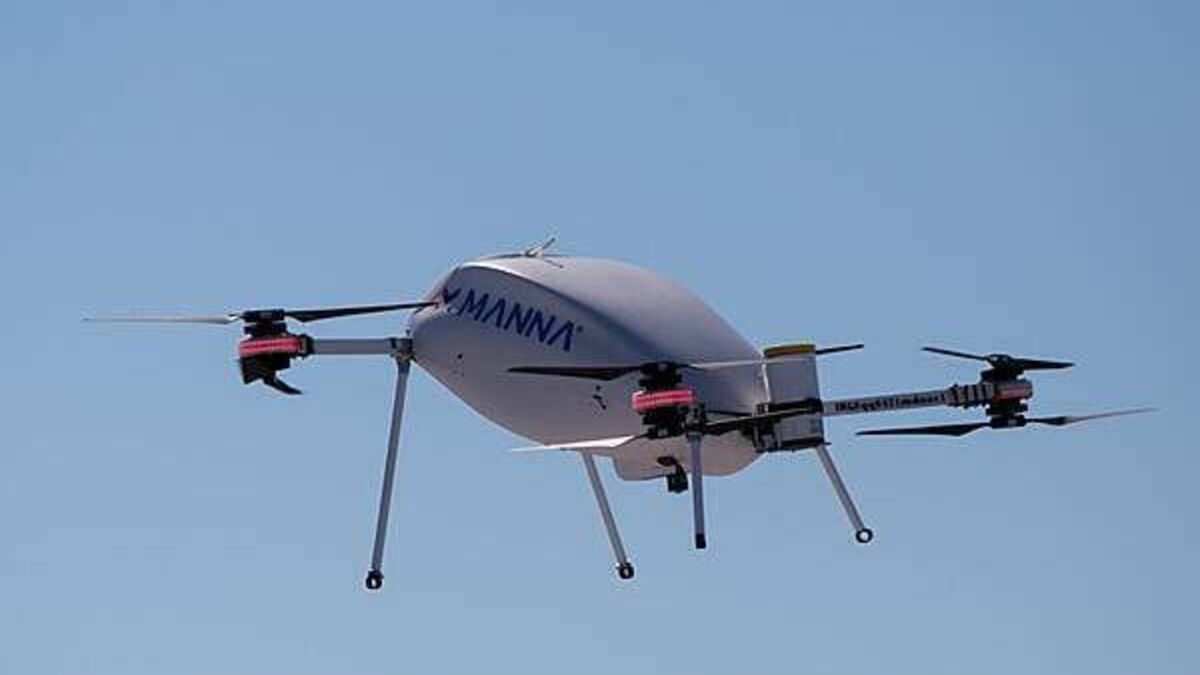
Contentious plans for a drone aerial delivery hub for Dundrum, opposed by a senior Dublin Catholic cleric, have been refused.
This follows Dún Laoghaire-Rathdown County Council refusing planning permission to Manna Drones Ltd for its planned aerial delivery hub on lands to the rear of Holy Cross Church in Dundrum.
The proposal faced local opposition, including one objection from Monsignor Paul Callan from Holy Cross Church and Pastoral Centre in Dundrum, which stated that “the prospect of a drone take-off during mass is simply unprecedented and disrespectful”.
Now, the Council has refused planning permission due chiefly to noise concerns.
The Council stated that the noise impact of the proposed aerial delivery hub and associated drone operations on residential amenity and other sensitive receptors, through the submitted Noise Impact Assessment, has not been sufficiently evidenced or modelled.
As a result, the Council has concluded that the applicant has “failed to demonstrate that the proposed development would not give rise to adverse noise impact or injury to the amenities of property in the area”.
The Council also refused planning permission over biodiversity impact concerns.
It stated that the submitted Ecological Impact Assessment does not provide a sufficient evaluation of impacts on biodiversity nor reconcile findings in the scientific literature with the conclusion of 'no significant effect’.
As a result, the Council stated that it is therefore not satisfied that the proposal can mitigate or avoid the likelihood of significant adverse impacts on relevant ecological receptors and species.
In the ‘Holy Planning Row’, planning consultant on behalf of Monsignor Callan, Ann Mulcrone claimed that the hub "would create a hostile noise environment and would seriously injure the amenities of the Church and Pastoral Centre and Parish House”.
When plans were first lodged by Manna in June 2025 216 third party submissions were lodged with the Council with 193 concerned with noise, 144 with privacy and 86 with safety.
In Monsignor Callan’s follow-up objection lodged last month, Mulcrone stated that the submission is made in the public interest of the community of over 4,700 homes that the Holy Cross Church and Pastoral Centre, part of the Catholic Archdiocese serves.
Monsignor Callan resides in the parochial house and Mulcrone stated that the community concerns about the impact of the noise have not been addressed by the applicant in the further information response.
On behalf of Monsignor Callan, Mulcrone said that the church “provides a quiet space of refuge and the variety of activities in the church and pastoral centre include mindfulness, meditation, stillness, yoga, therapy groups for young and old”.
“There is a fundamental land use conflict between the proposed use and the proposed use and the impacts on the Church have not and cannot be properly addressed as the proposed use is simply incompatible with the quiet environment essential to the Church and pastoral centre.”
“Daily flight numbers amounting to 288 flights from the aerial hub indicate a significant level of intensity which is a major land use conflict with the nature of the use of the adjoining Church and parochial house where there is a need for a quiet environment supportive of spiritual contemplation and prayer."
The planning refusal coincides with new accounts showing that expansion costs at the Irish arm of drone delivery firm, Manna Drones resulted in pre-tax losses rising to €16.9 million in 2024.
Accounts filed by Manna Drones Ltd show that the losses of €16.9 million for 2024 were a 37 per cent increase on the post tax losses of €12.33 million for 2023.
The firm revenues from drone deliveries increased more than six fold from €20,439 in 2023 to €136,004 in 2024 while revenues for 2025 are expected to be a multiple of what was recorded in 2024.
In 2024, the firm upped its R&D spend to €2.37 million from €2.1 milion while another contributor to the increased losses was a foreign exchange loss of €2.5 million compared to a foreign exchange gain of €808,073 in the prior year.
The accounts were signed off the directors, including chief executive, Bobby Healy, on June 11th.
A spokesman for Manna said Tuesday that “as a frontier tech company Manna has continued to invest heavily in R&D, more than doubling its headcount to nearly 200 people across manufacturing, robotics, regulation and aviation,”.
He said: “As a result these accounts reflect a deliberate investment strategy focused on scaling the business, expanding internationally and building the technology and operational infrastructure required for long-term growth.
The spokesman said that since 2024, Manna has continued to see strong growth in deliveries, expanded its operational footprint and announced further international expansion plans.”
Numbers employed at the Irish unit in 2024 increased from 90 to 97 as staff costs increased from €5.22 million to €6.62 million. The staff costs included severance costs of €157,507.
The company enjoyed a corporation tax credit of €593,582 in 2024.
In April, Manna announced plans for a further 400 jobs following a $50m (€43m) funding round that will drive growth at the company.
The new jobs, to be split between Ireland and the US, will be in robotics, software engineering, aviation and operations.
Manna Drones is the only European or Irish company competing with Google, Amazon and another company Zipline in the drone delivery sector.
The company has already completed more than 300,000 deliveries of books, medical supplies such as antigen tests, food and clothing, including 82,000 deliveries at its Dublin 15 base, and has expanded its operations to Texas and Finland.
It has plans to open more bases in Ireland, concentrating on locations outside the capital.
A spokesman for Manna said Tuesday: "Manna will study the planning outcome and is committed to growing its operations in Ireland and the United States.
“As part of the Dundrum planning process, independent expert assessments concluded that 'the predicted operational noise impact of the air delivery hub is insignificant” and that drone operations would result in “little to no perceptible noise level change’."
He said that the Operational Environmental Management Plan also concluded that there would be “no significant adverse noise impact associated within the standard operations of the drones” in relation to biodiversity and wildlife.
He said that these assessments were based on measured drone operations, detailed acoustic modelling and internationally recognised standards, including WHO guidance, the EU Environmental Noise Directive, EASA guidance, ISO standards and Irish EPA methodologies.