Jozef Puska loses appeal against backdating life sentence for Ashling Murphy murder
By Ryan Dunne
Jozef Puska has lost a bid to have his life sentence for the murder of Ashling Murphy commence from when he first went into custody, rather than the date the trial jury convicted him.
Despite Puska going into custody after his arrest in January 2022, trial judge Tony Hunt backdated the sentence only to when the verdict was returned in November 2023.
Barristers for Puska (35), who last week abandoned an appeal against his conviction for the murder of Ms Murphy (23), argued that the judge did not identify any basis for refusing to backdate the life sentence.
In exercising his discretion to do so, Jugdge Hunt said: "The backdate should be entirely academic anyway. Any rational system considering your release would have to take into account that we don’t know the why, and unless that becomes known, it seems to me, unless you are enfeebled by disease or old age, the question of your safe return to society will be or should be a very open one.”
Counsel for Puska, John Berry, told the Court of Appeal on Thursday that the only point in the appeal was whether it was appropriate for Judge Hunt not to backdate the sentence to the date the defendant was arrested in 2022. He said that the mandatory life sentence for murder is wholly punitive, but there was no basis identified by Judge Hunt for not backdating the sentence.
Counsel pointed out that there are cases where accused people enjoy bail before murder trials, who would find themselves in a markedly different situation than those remanded in custody before their trial.
Berry argued that when cases come before the parole board, the specified times at which sentences are to be reviewed are triggered by the date the person goes into custody. He said that when the question may be asked as to how long Puska has been in custody, the answer could be when he was sentenced or when he was arrested.
Judge Paul Burns said that all the court had to look at was whether the sentencing judge was right to exercise his discretion. He said that the additional suffering experienced by Ms Murphy's family might be the reason the judge decided not to backdate the sentence. Judge Burns also pointed out that the parole board considers how long someone has been in jail since sentencing, not how long they have been in custody.
Berry said that because this was a mandatory life sentence, there was no possibility to afford mitigation, so he asked whether it was appropriate for the sentencing judge to increase the amount of time Puska will serve, as no regard was given to the 22 months Puska had already been in custody.
Judge Patrick McCarthy, presiding over the three-judge court, said that Judge Hunt’s reason for not backdating the sentence was clear enough, as he gave regard to the character of Puska at the time of sentencing and the suffering of Ms Murphy’s family.
On behalf of the State, Anne-Marie Lawlor said that a judge has discretion as to the commencement of the date of sentence, with a sentencing court entitled to have regard to the culpability of a defendant and how they met the case against them.
Lawlor said that a court cannot have regard to any executive function at the time of sentencing, adding that there was no basis for the Court of Appeal to now establish there had been an error in principle. She added that Judge Hunt had set out precisely what he had regard to when sentencing, backdating the sentence to the date of the jury’s verdict and outlining the basis on which he did that.
In delivering the court’s judgment, Judge McCarthy said that a court cannot take into account probation issues when fixing sentences, and the court must exclude any question of remission and any consideration of any issues of the parole board.
He said that a sentencing judge has discretion as to whether to backdate a sentence to the date a person goes into custody, and in this case Judge Hunt had articulated his reasons not to do so. Judge McCarthy noted that Judge Hunt had taken the view that this was a case of the utmost seriousness, which was a perfectly relevant factor to take into account.
In summary, the court dismissed the appeal.
Puska, with a last address at Lynally Grove, Mucklagh, Co Offaly, had pleaded not guilty to murdering Ms Murphy at Cappincur, Tullamore, on January 12, 2022.
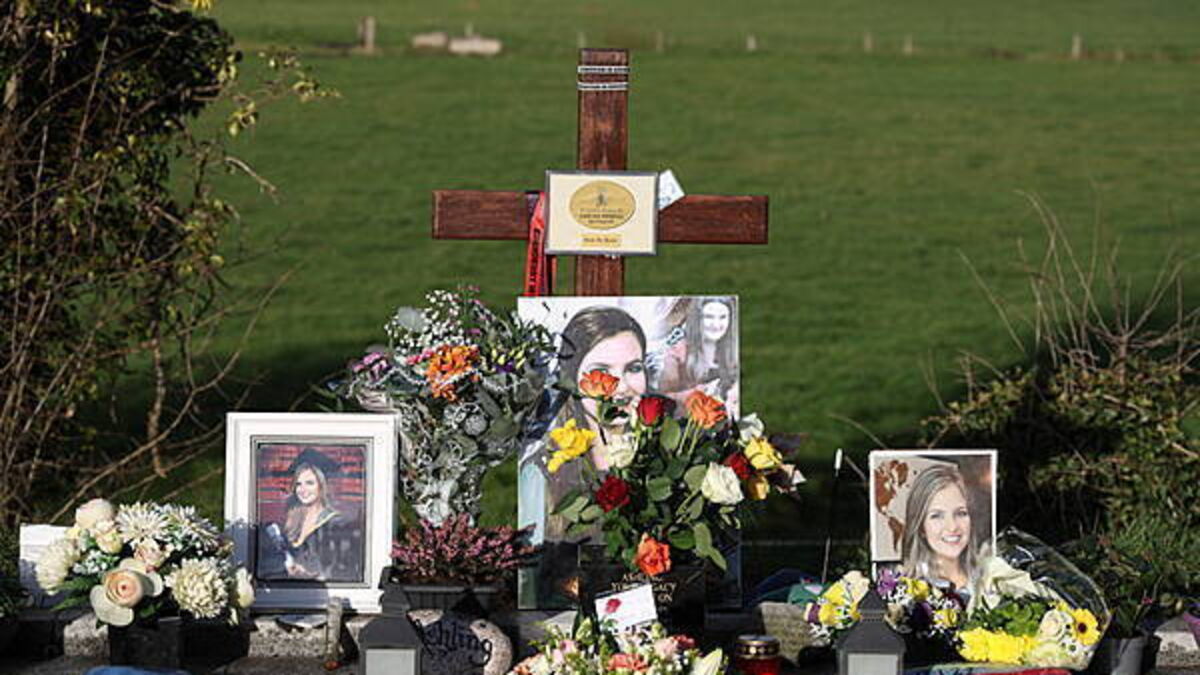
The jury found that Puska stabbed Ms Murphy 11 times in the neck and slashed her once with the edge of a blade before leaving her to die in the thick thorns and brambles by the side of the canal towpath between Tullamore town and Digby Bridge. A monument now stands where she died.
Puska was placed at the scene by the presence of his distinctive green and black bicycle, a few feet from Ms Murphy's body. He had been captured on CCTV cycling the same bicycle around Tullamore earlier that afternoon, stalking two women before heading towards the canal.
Puska's DNA was found on the bike, as was his fingerprint, while his DNA was also under Ms Murphy's fingernails. The prosecution argued that the DNA under her nails showed that Ashling had scratched her attacker as she fought to save her own life.
When gardaí spoke to Puska the day after the murder, his face and hands were covered in scratches that were consistent with him crawling through the thorns and briars by the side of the towpath where he murdered Ms Murphy.