Longest-serving firefighter Terry hangs up his helmet after 43 years
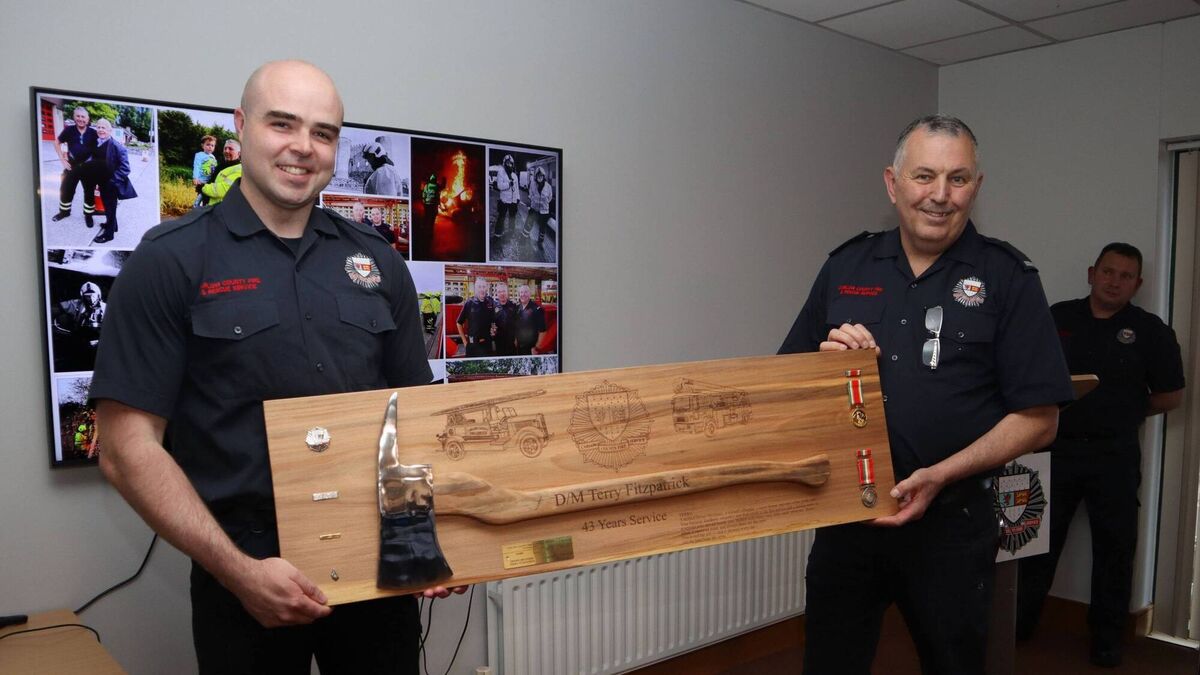
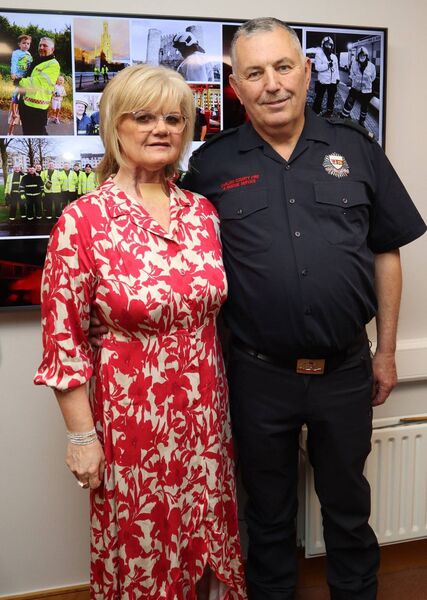
Ro Boyle presents Terry Fitzpatrick with a retirement gift from all his colleagues Photos: Paul Curran
WHEN Terry Fitzpatrick joined Carlow Fire Service on 31 May 1983, the call-out system relied on someone running to press a button that set off a wartime air raid siren heard across the entire town. Forty-three years later, he is retiring as one of the longest-serving firefighters in Ireland and the last man standing who fought the great Haddens blaze on Tullow Street.
He sat down with to reflect on a career shaped by courage, sacrifice and, he believes, fate.
There is a quiet philosophy at the centre of Terry Fitzpatrick’s life, words his father gave him as a young man that have guided him ever since: ‘if it’s meant to be, it’s meant to be.’ It was that saying, he recalls, that nudged him towards the fire service following his mother’s death. It is the same saying that he credits for bringing his wife Anne to him and it is the phrase he reaches for now, at 62, as he reflects on 43 years of service to the people of Carlow.
Terry left school at 14 and began an apprenticeship as a mechanic, but after his mother died his path was uncertain. His father, steady as ever, offered that simple counsel. When Terry said he wanted to be a firefighter, his father worried about the danger but backed him regardless. On 31 May 1983, Terry Fitzpatrick reported for his first shift with Carlow Fire Service.
He would not leave for 43 years.
The Carlow Fire Service Terry joined bears little resemblance to the one he is leaving. The equipment, the training, the very nature of the calls, all of it has been transformed beyond recognition.
“Back then it was a fire engine that gave out water and you had a hand cable at the back of the machine with a wire attached to the pedal to the truck to work the pump,” he explains. “Now, everything is electronic and there are gadgets.” Those gadgets include drones capable of gathering thermal imagery to survey a fire safely from above – a world away from the air raid siren that once summoned men to the station.
“If someone had a fire, they had to run to the phone box to ring 999 or they’d have to run to the station, press the button, which let off the air raid siren, and the first man down would sound the alerters from the station,” Terry recalls.
The nature of the emergencies has shifted just as dramatically. “When I joined, it was all chimney fires,” he says. “Seventy-five percent of our calls were chimney fires, and then you’d have a couple of road traffic accidents. Now, it’s almost the opposite. I would say barely 10% of our calls now are chimney fires and nearly all the rest are road traffic accidents.”
The philosophy of fighting fires has changed, too. “We used to fight house fires from the inside out. Now, it’s from the outside in. Back then, it was more of a labour-intensive job. Now you do your risk assessment and you’d nearly know what you’re going to do before you’d done any work at all.”
Acting chief fire officer Ben Woodhouse, who spoke warmly of Terry’s contribution, outlined how the service has broadened the range of specialist skills available across the station. “Now, all the firefighters can do all the essential roles that a firefighter needs to do, but we do have some firefighters trained in additional skill sets: driving vehicles on emergency blue lights, operating the high reach hydraulic platform, water rescue, and we have two firefighters in each station trained to be drone pilots.”
For all the changes in equipment and strategy, some things about firefighting never change. The danger. The split-second decisions. The moments that stay with a person for life.
Asked if he ever feared for his life in the line of duty, Terry says: “I had two close shaves in one night. In one night, and that was the only time.” This happened at a major fire in Tomard when the crew experienced a flashover, which is a terrifying, sudden ignition of superheated gases that can engulf a room in flames within seconds.
“The next thing all you could see was this big ball of flame coming over our head and it came down behind us and then the place went completely black,” he recalls. “None of us could see. We were only about 30 feet inside the door, but the evacuation whistle blew. When they ran, I had my feet between the hose and it sort of threw me to one side. So the boys ended up going out without me, and I couldn’t see where I was.”
His crewmate that night was Martin Mulhall, now also retired. “He had an idea where he was and he crawled back in on his belly. He got me and then the station officer at the time, Robert O’Connor, he got such a fright, he said, ‘you’re not going back in there, get up on the roof there. You can fight the fire from the roof’,” which subsequently nearly fell in with them on it.
Terry speaks of those early years with a kind of stoic candour. The culture then offered little in the way of emotional support or debriefing. “Back then, it was more of a ‘take it as it comes’,” he notes, a stark contrast to the critical incident stress management now available to crews. “You had to have a bit of courage ... none of us ever looked at it as being dangerous, what you were doing. You just got in and got it done.”
Among the many fires Terry has attended in four decades, one holds a particular place in Carlow’s collective memory. The Haddens fire on Tullow Street in 1984 gutted the premises, leaving what witnesses described as a gaping hole in the streetscape before it was eventually rebuilt. It remains one of the most significant blazes in the town’s recent history.
“I’m the last of the firemen in the whole county that fought Haddens fire in Tullow Street,” Terry says.
It is a distinction he carries with characteristic quietness. No boast. Just acknowledgement.
“I always took pride in my job. I never boasted about it.”
If there is one story that encapsulates Terry’s belief in fate, it is the story of how he met Anne, his wife of many years. It is not a straightforward story. It begins, as so many things in a firefighter’s life do, with a tragedy.
“We got a call in the early years to a drowning out in Milford. It was a 17-year-old named Joseph Gorman, and we took him out of the river. I didn’t know Anne at the time, but Anne was Joe’s sister.” The two paths crossed in grief, and then, in time, in something else entirely.
“I always remember when Anne asked me out and I remember my father saying – because I’m a shy person – ‘If it’s meant to come to you, it will come to you.’ And I always say that Anne came to me.”
They married and Anne proved to be the quiet backbone of a career that demanded an enormous amount from a family. Firefighters were required to live and work within five minutes of the station, on-call at virtually all hours, the rhythms of ordinary family life constantly at the mercy of a pager.
“I reared my family where the children might be looking to go to the beach on a Sunday and they either couldn’t go or they’d have to go without me and I’d be sitting there on call.”
Anne, he says, never once complained. “When we got married, she never once gave out to me for going to fires. She stuck by me all the way.”
To this day, he speaks of her with unmistakable gratitude. “I have to acknowledge Anne and the children for that, because I wouldn’t have been able to do it only for them.”