Carlow IFA launches campaign to highlight serious threat posed by uncontrolled dogs
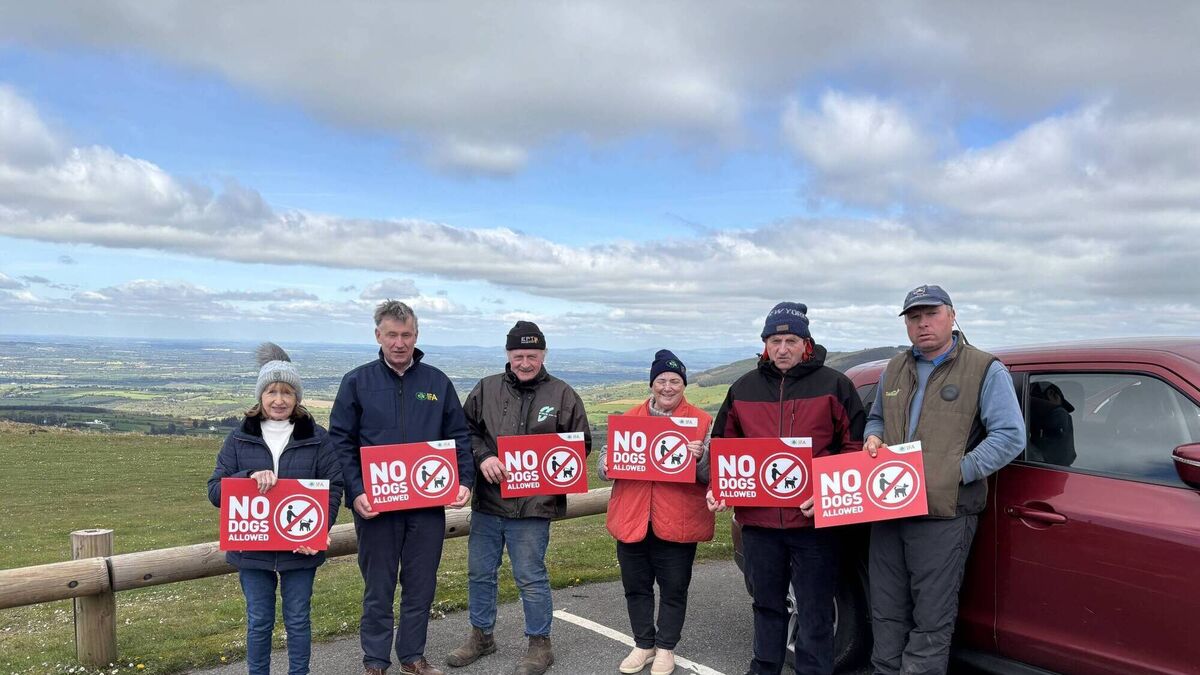
At the launch ofthe IFA's 'No Dogs Allowed' campaign at Mt Leinster were Hilda Rothwell, IFA Carlow chairman Michael Purcell, cllr Charlie Murphy, Marian Dalton, cllr Tommy Kinsella and sheep farmer Tomas Cearty
THE scenic Nine Stones viewpoint on Mount Leinster was the venue for the official launch of an annual campaign by the Carlow branch of the Irish Farmers Association to highlight the serious threat that uncontrolled dogs pose to sheep and other livestock.
The campaign has been running nationally for a number of years and is particularly relevant at this time of year as the weather improves and more people avail of the countryside for hikes and walks.
Carlow IFA chairman Michael Purcell urged all members of the public to act responsibly when out in the countryside, as the issue of dogs attacking sheep continues to be a major problem, despite the constant messaging.
“Sheep attacks continue to be a major concern for farmers across Carlow and beyond, resulting in significant financial losses as well as animal welfare issues,” he said.
“The campaign highlights the simple but vital message to dog owners: keep dogs on a lead at all times when near farmland and never allow them to roam freely in areas where livestock are present,” he added.
Despite the campaign being first launched in 2021, the IFA has long argued that the level of regulation and enforcement is not strict enough.
Under the , prosecution requires proof that a dog was directly observed worrying or attacking livestock. This means that in the majority of cases where farmers discover the aftermath but did not witness the attack, there is little the authorities can do.
Deputy chief veterinary officer at the Department of Agriculture, Dr Lorna Meaney, told the Joint Oireachtas Committee on Agriculture in January that the department is “committed to ensuring that microchipping legislation evolves in light of new challenges and opportunities”.
Currently, dog wardens are required to contact the register where a microchip was recorded to get the details of the owner of the animal.
“To improve this system, the department plans to create a centralised microchip database which will be available to DAFM inspectors, An Garda Síochána and dog wardens,” Dr Meaney told the meeting.
“When operational, an online portal will make instantly accessible all available details relating to a registered microchip number and the dog’s owner. This will mean faster identification of stray or injured dogs, easier enforcement of legislation, better accuracy of records and a reduced administrative burden,” she added.
In November 2025, minister for agriculture Martin Heydon announced that local authorities will receive funding worth a total of €2 million for the retention and appointment of additional dog wardens in 2026.
Local authorities are responsible for all operational and enforcement matters and have the power to seize dogs, impose on-the-spot fines and take court proceedings against owners.
The current fine for someone who is deemed not to be in effective control of their dog is €300.
In March, at the launch of a public awareness campaign to keep dogs under control heading into the lambing season, minister Heydon spoke about the potential for the fine to be increased in the future and said the issue of dogs worrying livestock was “critical”.
“I’m determined to ensure this critical issue becomes embedded in the consciousness of dog owners and ensure that dog owners understand their responsibility and the significant damage a dog can do to a flock if uncontrolled,” minister Heydon said.