The murder of Leighlinbridge native Mary Walker and a miscarriage of justice
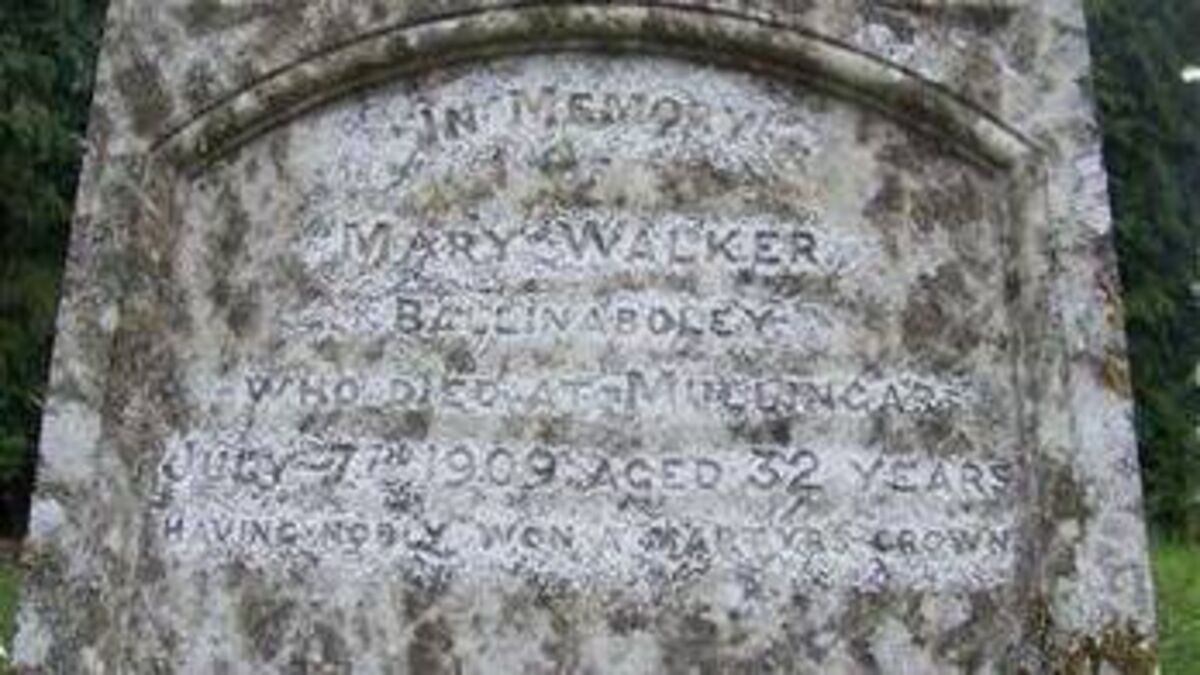
Mary Walker's headstone in Leighlinbridge cemetery
MARY Walker, a native of Leighlinbridge, Co Carlow arrived in Mullingar in 1901 to take up employment at the local post office. She was transferred from Blackrock, Co Dublin and had previously worked for the postal service in New Ross, Co Wexford and Callan, Co Kilkenny.
She was a regular churchgoer and was involved in local church activities.
Mary was a very friendly and obliging person and aided numerous people when her assistance was called upon. This mostly involved reading and writing letters, reading telegrams and filling in forms; and as such, she was deemed to be a very trustworthy person.
Her employment entailed working unsocial hours; this left her free in the afternoons and, if the weather was favourable, she was regularly seen strolling around the town or along the canal line. If the weather was bad, she would visit her many friends in various parts of the town and other times she would stay at home chatting with her landlady Mrs Anne Daly.
On the morning of Wednesday 7 July 1909, Mary got up early, attended Mass in the local cathedral and afterwards walked to the post office to start her early shift. She completed her shift at 1.45pm, left her place of employment and headed for her lodgings at 3 Fairview Terrace, Patrick Street; she arrived there at about 1.50pm.
Her landlady, as usual, had her dinner ready. Mary sat down and enjoyed her meal and afterwards relaxed with a cup of tea.
She then left her lodgings and went for a stroll; her landlady put the time at about 3.15pm. She would never again return alive to her landlady’s home.
Her body was found at 8.35pm – her throat had been cut. She was horrifically murdered on that summer’s afternoon. Mary Walker was 32 years old.
Mary was due home for tea at 6pm and when she failed to turn up, Mrs Daly became concerned. Later still, at 7.30pm, when Mary was due to return to work, Mrs Daly, who at this stage was very worried, sent her son Michael to the post office to enquire about her whereabouts. He was informed that she had failed to show up for her shift.
He then tried the neighbourhood in Patrick Street in the hope that she had called to see a friend and overlooked the time. He could not locate her anywhere.
Then, Michael, a clerk at the post office, together with two workmates, Thomas Nooney and John Lundy, decided to walk along the canal line to look for Mary. They went towards the racecourse on the side that Nooney had seen her earlier that afternoon. About a half-mile from town, one of them saw what he called a “white thing” in the hollow below the canal bank. They went down to see what it was and discovered that the “white thing” was a bare knee and saw Mary’s body covered with grass and her face covered with blood.
The deceased was lying on her back; the hollow where she was lying is between the canal bank and the railway line. The group returned to Mullingar and informed the police.
An inquest was held the following day and the police gave their evidence. Later, that evidence began to change – a new set of boot prints suddenly appeared on the railway side of the drain. The inspector actually brought the suspect’s boots out to the crime scene, got a policeman to put them on, thereby contaminating the murder scene.
The police admitted that the prints found at the scene looked like the suspect’s but were smaller than his and blamed the hot conditions for shrinking the boot prints.
They knew they wouldn’t get away with this at the assizes, as this type of evidence would be thrown out of court. The crown prosecution later scrapped the boot print evidence. However, it also kept from the defence the evidence that put the suspect, Joe Heffernan, in the town centre at the time a man was seen walking from the murder scene.
Unfortunately, as Heffernan was not legally represented during the magistrate’s court in Mullingar (the false, incriminating statements were used during that hearing), this evidence was enough to remand him to the assizes in Dublin. It also turned a lot of the locals against him.
Incidentally, Joe Heffernan was a small man, weighing 9st 4lbs and was 5ft 4.5 inches in height. His right hand was deformed. Physically, he would not be able to, as stated in the evidence of young Richard Monaghan, throw a larger, heavier person down the canal bank.
The boot prints were among the false evidence not used during the assizes in Dublin. Two honest statements, that of Mr Merlehan and Michael Murray, proving Joe Heffernan’s innocence, were also not used, especially about seeing a man walk away from the murder scene at about 5.10pm. And statements from three witnesses who put Heffernan in the town â one, at 4.50pm, another at 4.55pm and another at 5.05pm as he entered Mount Street in the town centre – were similarly withheld.
Other statements were altered. Young Ellen Woods, for example, gave information to the police and they, in turn, handed it to the newspaper, which published what she had to say. Later, while giving evidence during the magistrate’s hearing in Mullingar, she changed her evidence. Also, what she stated proved that she wasn’t on the canal line at the time in question and not one witness saw her there.
Surprisingly, the police didn’t bother about fingerprints from the crime scene: the handle of Mary’s umbrella, her handbag, belt, boots and so on could have contained prints; maybe they did, and Joe Heffernan’s fingerprints were nowhere to be seen.
Similarly, question marks hang over evidence about the police finding a knife. Three policemen, a sergeant, the constable in charge of the case evidence and constable Rowlette were searching a tunnel. Rowlette, in his statement, said that he found a knife; he didn’t hand it over to either the sergeant in charge of the search party, or the constable in charge of the case evidence. He said that he kept the ‘knife’ in his possession and he handed it in at the police barracks the following evening, more than 24 hours after allegedly finding it.
Seemingly, the two other police officers knew nothing about the ‘find’ as neither mentioned it in their statements. But this discrepancy wasn’t mentioned during the assizes when the knife was produced. Incidentally, the police didn’t check this knife for fingerprints either.
Either Joe Heffernan’s legal team never bothered to research the evidence contained in all the statements or, on the other hand, the crown prosecution deliberately withheld from the defence the existence of statements that would prove Heffernan’s innocence.
A crown prosecution witness, Professor McWeeney, stated during the assizes that he used the Precipitin Re-action blood testing system while checking Joe Heffernan’s clothes. At that time, this system was far from accurate and it was not until the 1930s, more than 20 years later and following numerous improvements to its accuracy, that this system was used as compelling evidence in British courts.
The Precipitin Re-action system was mentioned in an attempt to bamboozle and impress the jury. Professor McWeeney also stated that Heffernan’s shirt was full of minute blood spots, adding that they resembled those often seen on the undergarments of verminous individuals. Prof McWeeney continued: “The prisoner was not a person affected with vermin.”
I have copies of all the original statements in my files at home; they make unbelievable reading. The police, in order to get statements to strengthen their case, released two prisoners from jail. One was an informer, Luke Sullivan, who was brought in to alter the evidence that two Crown witnesses swore during the magistrate’s hearing in Mullingar. Those witnesses said they saw “Heffernan walking towards the tunnel at 10.30am”.
That’s the reason the police gave for searching the tunnel three days after the murder, when they said they found the knife there.
Actually, Heffernan was thinning vegetables at a farm in Robinstown at that time, 10.30am, so their times didn’t suit and had to be altered. Sullivan’s statement gave the time he saw Heffernan at the tunnel as 8.55am. His statement was written, signed and witnessed on an informant’s form in October, three months after the alleged finding of the knife.
The other released prisoner was Elizabeth Flanagan’s mother. Elizabeth also gave unbelievable evidence, such as Heffernan cleaning what the police said was a brand-new pipe, supposedly purchased that day. This was an attempt to prove the suspect was what he wasn’t, a pipe smoker, and as such he would have had a knife to cut tobacco.
There were prior attempts to have these prisoners released. However, the local magistrates and Dublin Castle refused, stating: “Let the law take its course.” That was until the police came up with an idea and offered these convicts a deal.
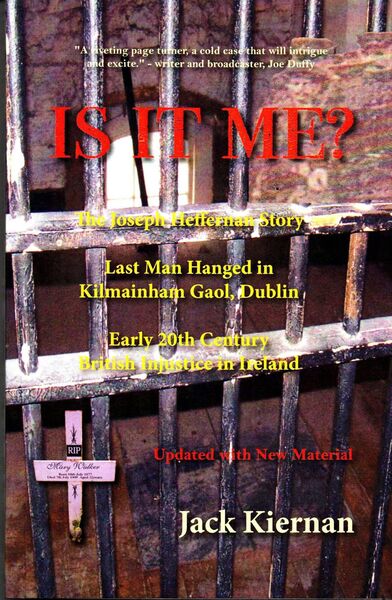
Joe Heffernan, an innocent man, was found guilty and executed on 4 January 1910.
He was the last man to be hanged in Kilmainham Gaol.
I could go on and on about the conduct of the police as they investigated this murder case, but this is not the time nor the place.
At the time of her murder, Mary’s mother Ellen, a 63-year-old widow, lived at the family home in Carlow with her son William (22) and her daughter, Julia, Mary’s 20-year-old sister. Her mother gave birth to five children, but only three survived. Her husband died after 17 years of marriage and later Mary was murdered.
It’s not natural to bury a child, but to bury three children is more than a tragedy. God only knows how Ellen coped for the rest of her life.