Eurovision: Bookies' favourite Sweden might overtake Ireland as country with most wins

By Charlotte McLaughlin, PA Senior Entertainment Reporter in Basel
The 2025 Eurovision Song Contest final in Switzerland will have to “wait and see” if Celine Dion performs, while Sweden could move clear of Ireland to become the most successful country in Eurovision history.
Sweden is the red-hot favourite for this year's Eurovision Song Contest on Saturday in the Swiss city of Basel, with an offbeat song about saunas which could cool some recent controversies at the show.
Bookmakers give Sweden's entry, comedy trio KAJ, a 42 per cent chance to win the world's biggest music event, which is taking place amid protests over participation by Israel, which is continuing a military assault on the Palestinian enclave of Gaza.
A win for KAJ would be Sweden's eighth overall, moving it clear of Ireland's seven wins.
Ireland's 2025 representative Emmy Kristiansen failed to get through in Thursday’s semi-final.
KAJ's song, Bara Bada Bastu, translates as "Let's Just Sauna" and celebrates the power of saunas.
"It is a cherished way of everyday life, just relaxing and connecting and like staying quiet," KAJ member Kevin Holmstrom said before the final.
There has also been speculation that Canadian singer Dion, who won for the Swiss in 1988 with Ne Partez Pas Sans Moi, could take to the St Jakobshalle stage, amid her stepping back from touring due to health issues.
She did appear during the first semi-final on Tuesday, where she sent a video message saying she wants “nothing more” than to be in Basel, and recalling her triumph as a “life-changing moment”. Switzerland had not seen a winner until Nemo last year.

At a press briefing on Saturday, Eurovision director Martin Green, from the European Broadcasting Union (EBU), commented on Dion, saying: “My answer was going to be, Father Christmas exist, you’ll have to wait and see.”
When asked by the PA news agency if he was feeling relieved that the contest has not seen significant incidents so far compared to 2024’s Malmo, when protests and politics overshadowed the singing event amid the outbreak of war in Gaza, he said that he was feeling “quite emotional”.
Appearing to break down, Mr Green added: “I would be lying, of course, if we didn’t come into this hoping that we could re-establish a sense of unity, calm and togetherness this year in a difficult world, every single person over the past few months has worked to make that happen, not by force, but through conversation and demonstration of common-held values.
“And we have 12 hours to go, and if we get there, and I think we will, I am just in awe of this thing for making a really profoundly beautiful statement to the rest of the world.”
A small group were ejected from the arena after Israeli singer Yuval Raphael’s rehearsal on Thursday was disrupted by what appeared to be pro-Palestinian demonstrators with “oversized flags and whistles”, and the EBU confirmed it has received a complaint from Israeli broadcaster Kan over another incident.
This year, there is no ban on types of flags brought in by fans, unlike acts, but there are restrictions on their sizes, as Palestinian symbols have been seen inside the arena this week.
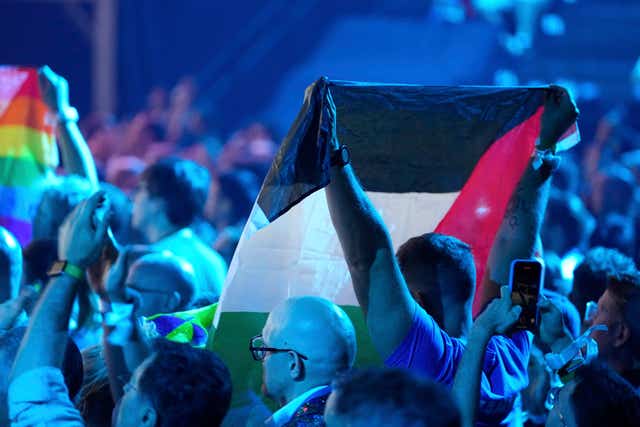
There were pro-Palestinian protests in Basel on Sunday and Wednesday, which were attended by no more than 150 people, police said, a significant drop from Malmo 2024, which saw thousands of marchers demonstrating against Israel’s inclusion.
On Thursday, a protest was held against antisemitism by around 150 people, which went without incident.
Last year also saw Dutch singer Joost Klein kicked out of the competition by the EBU over alleged verbal threats to a female production worker, which he denied.
Beat Lauchli, the project manager for Eurovision with Basel city, said that local police are “ready” for the pro-Palestinian protests on Saturday night and will have more officers on the streets for the final.
Other favourites this year are Austria’s JJ (Johannes Pietsch) with the emotional song Wasted Love and October 7 survivor Raphael, who will see her country join Luxembourg, France, the Netherlands and the United Kingdom on five wins if she lifts the trophy with the ballad New Day Will Rise.
Also in the mix are Finnish leather-wearing Erika Vikman with the innuendo-laden German language song Ich Komme, France’s Louane with the soulful Maman, and Dutch singer Claude Kiambe’s touching C’est La Vie.
There has also been buzz around host country Switzerland’s Zoe Me with Voyage, Estonia’s Tommy Cash with Italian parody Espresso Macchiato, and Malta’s Miriana Conte, who changed her song’s title, Kant, due to a complaint about its similarity to an English language swearword, to Serving.
The winner will be determined by a combination of points from national juries and viewer votes in the participating 26 countries, along with a separate rest of the world poll.

The grand final will also see previous Eurovision runners-up Croatia’s Baby Lasagna and Finland’s Kaarija perform, as well as singer Nemo with their new song Unexplainable.
The Basel government said more than half a million people have visited the city so far this week after the competition came home to Switzerland, which first hosted it in 1956 in Lugano.
TV coverage for the final will be provided by Marty Whelan on RTÉ One and by Graham Norton on BBC One at 8pm on Saturday.