Dermot Mulligan’s legacy will echo down the ages
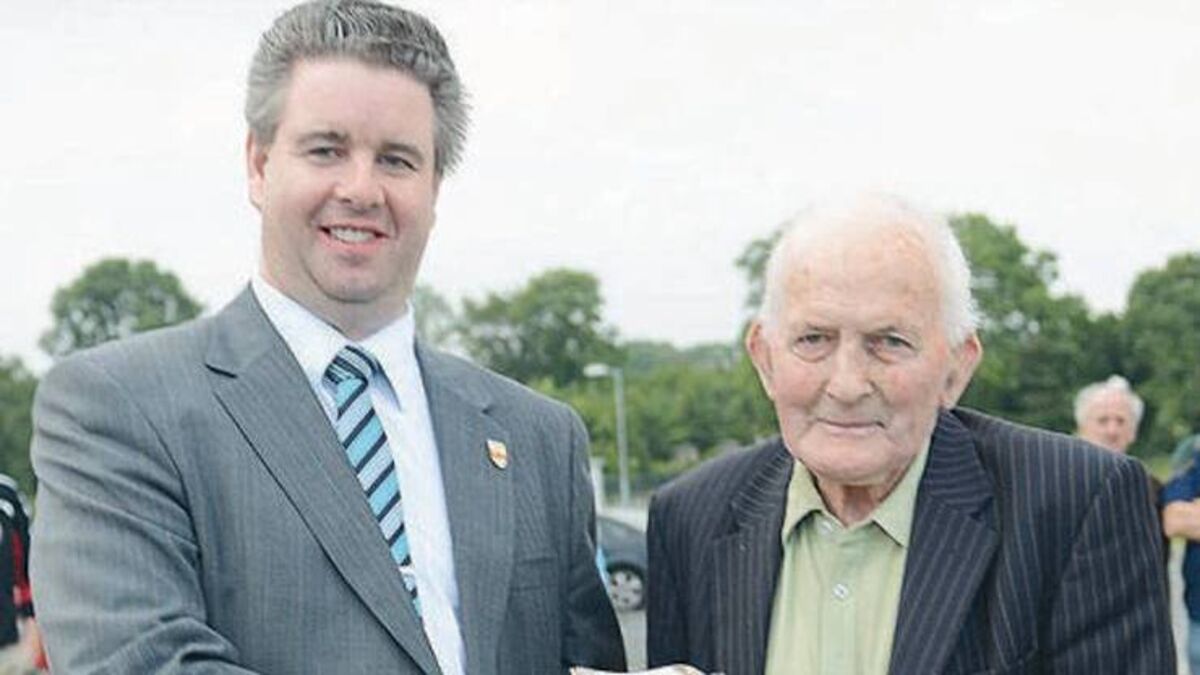
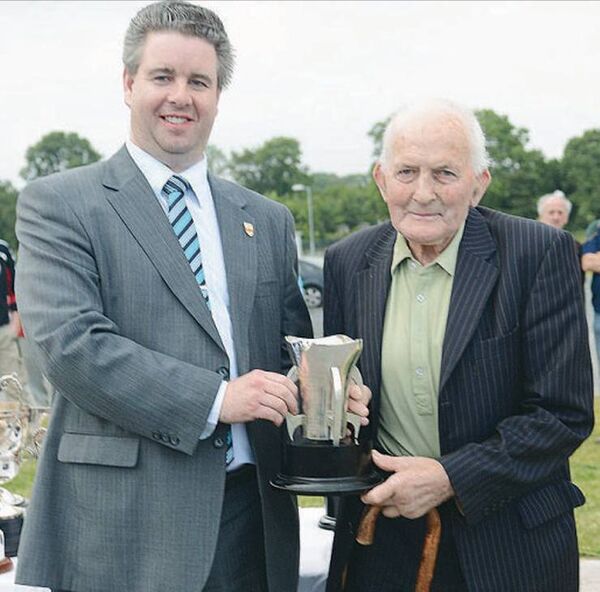
Dermot Mulligan and Martin Lennon.
Many people this week have spoken and written about Dermot’s beaming smile, but on this occasion what I witnessed from the back of the stand was another trait, a trait I dare say the many people who worked alongside him would have seen over the years. Dermot gave an almost imperceptible bounce, lay one hand over the other in front of him and instead of that smile there was a look of contented satisfaction.
Dermot, of course, would have been aware of the possible historic nature of the evening for as curator of Carlow Museum he had become the custodian of our most treasured GAA artefacts, most notably perhaps, the Haughney Cup, a storied trophy steeped in the history of Carlow football while it was Dermot who set in motion the circumstances that saw the 1944 Carlow v Kerry All-Ireland Senior Football Championship semi-final match programme rest in its rightful home in his beloved College Street Museum.
I was expecting to see Dermot in Croke Park again last Saturday at the hurlers Joe McDonagh Cup final, the proud Carlovian once more sporting his tri-colour jersey. In fact, I was hoping to talk to him about our red, green and yellow colours as last week’s column on Diarmuid Broderick had again floated the legend that the yellow of Milford was added to the red and green of Graiguecullen after a clash of jerseys with Mayo in the 1933 All-Ireland Junior Football semi-final.
Dermot, you see, a keen historian and a believer in facts, not legend, had a heraldic reason dating way, way back for Carlow’s red, yellow and green. I wanted to revisit this reason as when he originally sign-posted this information by steering me to the relevant part of the Museum I was in denial and preferred to take the stance of the newspaper man in ‘Who Shot Liberty Valance’ who said “when the legend becomes fact, print the legend.”
Dermot probably knew this too but remained quietly persistent and on one occasion when I was doing a bit of research in the upstairs rooms of the library I was approached by a young lady who said she was delving into the story behind the Carlow colours. I, of course, immediately relayed the Milford/Graiguecullen tale I had heard from old men in the pubs of the town. She listened attentively and then said her mentor would require proof. Her mentor, of course, was Dermot Mulligan who knew there was no proof!
A few years later Palatine’s John Kelly, compiler of the fantastic book on GAA programmes, when working on a gaelic games thesis carried out an exhaustive investigation that poured scorn on the legend, finding proof that the Carlow colours had been registered as red, yellow and green prior to 1933. Dare say part of John’s research would have involved talking to Dermot Mulligan who upon hearing the outcome would have smiled that famous smile.
On the story resurfacing in last week’s column I had it in my head to talk to Dermot and this time give his story of the Carlow colours the column inches they deserved. Instead those column inches are devoted to Dermot Mulligan himself, whose sudden passing last Sunday at just 51 years of age has sent shockwaves throughout Carlow and beyond.
Then at his moving funeral mass in Askea Church – celebrating it’s 50th birthday, just a year younger than the boy born and reared on the nearby Tullow Road – work colleague John McDarby in an emotional eulogy told the congregation that Dermot brought ‘scholarship and passion’ to his role of curator of Carlow Museum.
Scholarship and passion, the perfect phrase.
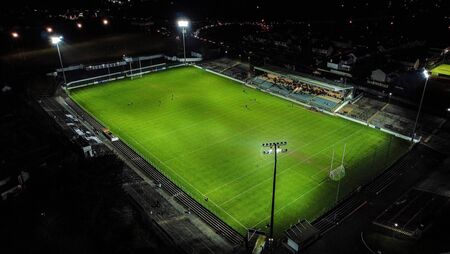
The source of the epidemic has been traced to a building beneath the Tommy Lennon stand in Dr Cullen Park and the upstairs room of the office behind the scoreboard end goal. Four men are currently under ‘house arrest’ for their part in fuelling the fires of nostalgia by conspiring to bring together the biggest collections of GAA memorabilia ever seen in these parts.
“Carlow Museum curator Dermot Mulligan, the Carlow County Board Tommy’s, Murphy and O’Neill, as well as Donie Nolan of photographic fame have happily pleaded guilty to their crime and have intimated that they will willingly do the time. The time, in this particular case, is a pleasant trip down memory lane as lovers of Gaelic games in the county view the vast array of cups, medals, cuttings, programmes and photographs that adorn both viewing areas.”
The ’vast array’ would not have been as accessible or as beautifully presented without Dermot’s ‘man of the match’ in-put, the glass cases, the printed posters, the general lay-out all down to his exceptional expertise. His reassuring presence also gave that successful project real impetus as his personality was one that brought people with him while Dermot was not above immersing himself in the nitty-gritty either, he part of the gang who were taping Donie Nolan’s photographs on to whiteboards on the eve of the launch.
It was from that same pen in his columns before and after the Leinster final that the words of the famous ‘Carlow fifteen’ song came. Many stories have travelled down the ages of Carlow’s 1944 exploits, culminating in the great Leinster final victory over Dublin in Athy and that all-Ireland semi-final meeting with Kerry.
While newspaper cuttings of the time were lovingly pasted into scrapbooks one item of memorabilia, which seemed not to have survived, was the programme from the clash with the Kingdom. Though 40,727 paid gate receipts of £2,515 to gain entry to Croke Park, a huge percentage of them sporting red, yellow and green Carlow favours, few seem to have brought home a programme. It was a damp, wet day and that might have rendered many of the four-page fold-overs unsavable.
However in May 2008 the Carlow County Museum jumped at the opportunity of acquiring both the official and unofficial Carlow v Kerry match programmes when they appeared for sale at a sporting memorabilia auction in Booterstown, Co Dublin. With the generous financial assistance of the Carlow Town Council, the Carlow County GAA Board, the Friends of Carlow GAA and the Carlow Historical and Archaeological Society, both programmes were purchased.
You could say Dermot Mulligan threw in the ball as regards acquiring the programmes and having done the ground-work he hand-passed to Martin Nevin who attended the auction. “Martin, like the men of ’44, held his nerve to bring home the laurels,” said Town Council Chairman, Tom O’Neill at a pleasant function in the Town Hall one Monday afternoon a year later as he, on behalf of the Town Council, presented a framed copy of the programmes to Pat Deering, then Chairman Coiste Chontae Ceatharlach CLG.
The ’44 programme alone, from a GAA point of view, would have been an outstanding legacy for Dermot to have left but his legacy is much, much bigger than that, he wrapped the history and heritage of his beloved Carlow into such an attractive package that that history and heritage and the name Dermot Mulligan will echo down the ages.
To Dermot’s wife Grace, mother Joan, sister Mary and to all bereaved by his elevation to the museums in the sky goes our deepest sympathy.