Carlow’s taken some big hits but there’s a lot to shout about, say local businesses
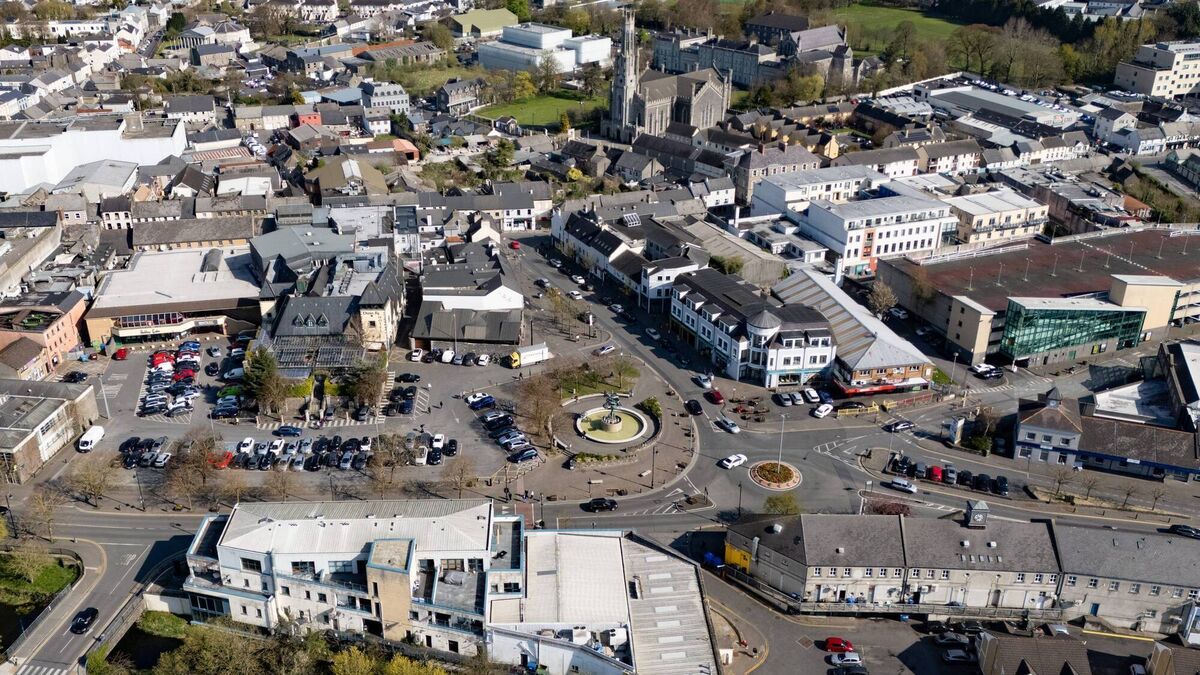
An aerial view of the centre of Carlow town Photo: michaelorourkephotography.ie
“CARLOW could do with shouting a little bit more” about how successful businesses in both the town and county are — that’s according to Carlow Chamber of Commerce chief executive Nicola Doran.
Her sentiments are echoed by local independent businesses, public representatives, the local enterprise office and local gardaí.
There is no denying that the town, which now has a population of 27,000, surpassing that of neighbouring Kilkenny by 2,000, has taken some big hits, and some people are struggling to get past that.
The loss of the Sugar Factory 21 years ago, the car components manufacturer Läpple closed in 2007 and personal care and hygiene products producer Braun shut its doors in 2009, all of which still loom large in minds of Carlovians. Which is not surprising, given that the combined job losses from those businesses were close to 1,000.
“There has been a gradual improvement since then, and oftentimes people don’t see that,” explained Ms Doran.
“There is an attitude in Carlow that you can’t be too showy and you can’t be showing off too much. I think this is an innate type of attitude.
“We do the Carlow Business Awards every year and we come across businesses we have never heard of that might have been operating in the county for years because they’re not talking about it.
“Kilkenny will tell you, and Galway will shout about how good they are. I want to shake people sometimes and say to them, ‘look what we have and look how well we have recovered from what was a very tough scenario’.”
Ms Doran pointed out that “as a chamber, we have discussed this issue a lot over the past two to three years that Carlow sometimes suffers from incorrect perception as to what exactly is happening. There is often negativity where negativity is not justified.
“Sometimes I think it’s a throwback to an era when the Sugar Factory, Läpple and Braun closed. People felt, and rightly so, that the economy was in a very sticky situation from an employment point of view.
“My memory of driving through Carlow 25 or 30 years ago is that there were a whole load of derelict buildings on Barrack Street and there wasn’t a whole load of business going on. There were plenty of people around, but it just felt down at heel.”
There are now up to 1,500 businesses operating in Carlow town and county, according to the county council, almost 300 of which are members of the chamber. South-East Technological University (SETU) with a campus in Carlow is creating and working alongside small, medium and large businesses, such as Merck, Sharp and Dohme, to tailor courses to inject inward investment in terms of not only finance but also halting the brain drain of graduates.
Ms Doran’s sentiments are backed by Independent Ireland councillor John Cassin, who goes further and points to Carlow needing “strong leadership and initiative” to improve the town even further.
Cllr Cassin put the emphasis on “small or little tweaks that can have such a big impact and such a big change”.
He continued: “The mayor (currently Fianna Fáil’s Ken Murnane) needs to walk around the town and see what businesses want. There needs to be more public meetings involving local representatives and council officials, along with meeting various groups individually. This would help them to understand the needs and wants of various businesses.
“For new businesses or those exploring whether they will choose Carlow as a place to set up, they need to understand how other entities have changed their business model to survive.”
He believes that “reducing vacancy numbers of shop sites with independent businesses and helping to establish short, medium and long-term goals through the council will also encourage more inward investment. Short term would be to bring people into the town centre, medium is to keep them in and long term is keeping them all happy.
“Low-cost changes will make a huge difference — just look at the flowers in the town. Why not arrange a simple town centre narrative? Businesses need to talk to the gardaí to allay any fears about crime being felt by businesses, residents, the elderly and vulnerable who may feel afraid.”
The councillor, who has lived in Carlow for most of his life, also pointed out that there needs to be a “clear, visible focus on streets with an economic mix of shops and more residents. There shouldn’t be a repeat of business in one concentrated area.
“Local government needs to change that, while urban spatial planners need to drive different ways of using sites and concepts available to them. This is just a very simple example, but there is no shop where you can get an ice cream on one of our primary shopping areas, Tullow Street.
“The council has done a huge amount of work over the last number of years, but there needs to be more joined-up thinking.”
One new business which has captured the imagination of Carlovians was set up by two young men who were willing to take a punt on Carlow town. Cian Waters and David Seitz opened Waterlilies café on Tullow Street in February 2022.
The 35-year-olds, both of whom are chefs and who became friends during their university days, explored Dublin and Carlow as options for opening a café suited to their vision, and they were not afraid to dip their toes into the evolving business landscape.
“We very quickly decided on Carlow as we wanted to offer something that a community didn’t have, rather than doing it in a place where we were naturally competing. In Carlow, there was an opportunity that wasn’t available to the people â a sourdough bakery, pastries and coffee of the standard we wanted to do,” explained Mr Waters.
“We had a vision for something; we didn’t see it here, so we decided to create it. We came to this building during lockdown and we ended up renovating it ourselves, one builder working with us. So we came here pretty much for a full year renovating the building.
“With the money we had, we weren’t going to be under as much pressure to open almost instantly as would have been the case in Dublin. If we had opened there, we wouldn’t be able to follow through on the creative vision for the building and also the products we wanted to do — that’s always a developing side of our business,” Mr Waters pointed out.
“We wanted the freedom to do something in the community, connect to the community from a business point of view and from our own personal sense of feeling like we weren’t just going to be another cog in a wheel. We may build up to do something in Dublin in the future, but that’s the future.”
Since then, and around the same time, other places have opened which is helping to create a niche café culture in the town centre. The café is now open seven days a week and customer numbers are increasing, with a second location in Tullow which opened in 2023.
Mr Waters explained that the café’s ethos is centred around “trying to do things as honestly as we can, have an atmosphere where we speak openly and freely with the customer â people do matter and they shouldn’t feel like a cog in a wheel.
“I spend 98% of my time in Carlow — I feel happy and safe here. Carlow is great and has so much potential to be something beyond that.” When they were opening their business, they received help from the local enterprise office. “They were very helpful to us and we still have an active relationship with them,” he continued.
But setting up in the town centre has not been without its setbacks, such as the decision not to pedestrianise Tullow Street.
“We make decisions which may not always work â I’d love to see the street pedestrianised, as I campaigned for it to happen, but people rejected it and it was a little bit upsetting. It was such a clear thing; it would become this really special place in Carlow. A pedestrianised street would have been more inviting, an epicentre within Carlow town. I probably witnessed for the first time my motivation withering away due to the decision.
“We tried to create a wine night here — it didn’t work as no-one walks through the town at night time, there’s no spontaneity. There is something that’s missing, but there’s an opportunity. There seems to be a tornado of confusion that blows around the town, but there is such an opportunity here. I think it’s because people feel excluded, and that hampers the town reaching its potential.